downthetubes is undergoing some main site refurbishment...

This blog is no longer being updated

The downthetubes news blog was assimilated into our main site back in 2013.

Hop over to www.downthetubes.net for other British comics news, comic creating guides, interviews and much more!
Showing posts with label TV Comic. Show all posts

Wednesday, 26 September 2012

10 Questions: Author Paul Scoones


On sale now from publishers Telos Publishing is The Comic Strip Companion: The Unofficial and Unauthorised Guide to Doctor Who in Comics: 1964 — 1979. Written by New Zealand author Paul Scoones, the book documents the early history of one of the world's longest-running comic strips – and certainly, perhaps, the longest-running licensed science fiction TV-inspired comics.

First launched in the pages of Britain's TV Comic in November 1964, the comic strip version of Doctor Who is just one year younger than the television series on which it is based. This is its story.

Paul's book chronicles the first 15 years of the Doctor Who comic strip from its origin in TV Comic to just before the ongoing strip was launched as a regular feature in Doctor Who Weekly in 1979. During this time more than 200 comic strip stories were published in the pages of TV Comic, Countdown, TV Action, TV Century 21, The Dr Who Annual and the Dalek books.

Every strip is covered in depth, including plot details, continuity, points of interest and analysis. Plus, for the first time, details about the creation and development of the adventures are documented, alongside comments from some of the original writers and artists.

Paul Scoones (www.paulscoones.com) was born in London, England in 1968 and moved to Auckland, New Zealand in 1973. His earliest memory of Doctor Who is from March 1975 when Jon Pertwee’s Doctor made his New Zealand television debut in the first episode of Spearhead from Space. He became completely hooked on the series five years later when he started collecting Target novelisations.

Paul, who lives in Auckland, New Zealand, created and edited the internationally acclaimed fanzine TSV (Time Space Visualiser – whose contributors include former 2000AD editor David Bishop and current Doctor Who comic strip writer Scott Gray) and runs the New Zealand Doctor Who Fan Club (www.doctorwho.org.nz). Paul also helped discover a film of the previously-lost Doctor Who episode ‘The Lion’ (episode 1 of The Crusade) and arranged its return to the BBC in 1999.

His credits are numerous - he has worked in a bookshop, managed online retail stores such as Retrospace (www.retrospace.co.nz) with his wife Rochelle, and edited websites for an electronic appliances retail chain. and include production information subtitles for Doctor Who DVDs. He can be seen on several Doctor Who DVDs, discussing finding a lost episode and commenting on the comic strips.

While he has had articles published in Doctor Who Magazine, In-Vision, The Handbook and Talkback, The Comic Strip Companion is his first professionally published book.

downthetubes: What is the appeal of the Doctor Who comic strip to you?

Paul Scoones: I’ve been a Doctor Who fan most of my life, and I’m fascinated by comics, so the combination of the two is naturally hugely appealing to me. The comic strip is a superb medium for Doctor Who. Unhindered by the limitations of television production budgets, the strip has the capacity to convey the broad potential of the series format. During the mid-1980s in particular I consider that the strip often surpassed the television series in quality of its story-telling and visuals.

downthetubes: How did the 'Comic Companion' come about?

An early Doctor Who comic spread from TV Comic
Paul: I’d had the idea for a book about the comics in mind for quite a while. It was originally going to be a series of fanzine articles. As a collector of Doctor Who books, I could see that there was a gap in the reference collection. There are plentiful guides to the series on television, as well as the spin-off audios and novels, but nothing specifically about the comics, which stuck me as an odd omission considering that the Doctor Who comics have a history that is almost as long as the television series itself.

What held me back from writing the book was that I felt the story needed to be told from the strip’s beginnings in 1964. Although I had a complete run from the first issue of Doctor Who Weekly in 1979, there were sizeable gaps in my collection for the first 15 years of the strip. That changed when I befriended a number of Doctor Who comic collectors and through them was able to complete the set of 1960s and 70s strips.

I wrote up a sample section for the book (covering the TV Comic strips from the first half of 1975), and submitted it to David J Howe and Stephen James Walker at Telos Publishing, who have a reputation for high quality, exceptionally well-researched books. They felt it was a good fit for their range and commissioned me. 

downthetubes: How long did it take to research - and what were the most difficult aspects of the research?

Paul: The book took five years to research and write. That’s much longer than I intended, but soon after I started work I was offered work writing production information subtitles for the Doctor Who DVDs, so I ended up writing the book in between subtitle scripts.

A great deal of information came to light over those five years that I might have missed out on had I finished it sooner. The book started out as a fairly straightforward story guide, but it has finished up as something far more detailed. I have gleaned a lot of hitherto unknown information from BBC Written Archives paperwork files, and from interviewing a number of people who worked on the strip.

The most difficult aspect was trying to fill the gaps in the writer and artist credits. The strips very rarely carried credits, so that information had to be pieced together from various sources. The book identifies most of the creators, but there will probably always be gaps in our knowledge concerning who was responsible for certain stories.

The Daleks did not feature in the
TV Comic version of Doctor Who
when it began
downthetubes: What was the strangest thing for you about the genesis of the Doctor Who strip that you discover writing this book?

Paul: The first comic strip story proposal was rejected by the BBC for including the Daleks. TV Comic went into the deal with the BBC thinking that they had the rights to use the Daleks and prepared a storyline in which the Doctor has a return encounter with the monsters. The BBC had to point out to them that the comic strip licence didn’t extend beyond using the Doctor and his TARDIS - the Daleks were off limits. The story that ended up appearing in print was a thinly veiled rewrite of the original proposal, with the Kleptons and the Thains taking the place of the Daleks and Thals.

downthetubes: Were you surprised by the amount of involvement the original Doctor Who production team had in the creation of the strip back in 1964?

Paul: Yes! Before getting to see the paperwork I expected that the people making the television series would have remained hands-off when it came to the comic. That’s the impression gained from reading the strip; a number of the early stories feature magic and mythical characters that would never have been acceptable in the television series. As it turns out, both Verity Lambert (Doctor Who’s first producer) and Donald Wilson (BBC Head of Serials) were both consulted and offered their feedback.

The paperwork reveals that later producers and script editors also kept an eye on the comic strip and sometimes vetoed certain aspects. One particular story, detailed in the book, was rejected outright by the production team.

downthetubes: Are you disappointed that for a title with a very visual subject matter, you were not able to feature very much source material?

Paul: Not at all. That might seem odd given that I’m writing about the visual medium of comics, but I’ve read plenty of books about television series that don’t have any photos, and I don’t regard this as any different. From the outset I knew that the book would necessarily have to be all text. I set out to write a book that would appeal both to readers who have not seen the comics - many of which have not been in print for decades - and also those who have the strips to hand.

The book is not entirely devoid of illustrations. There is an eight-page colour section in the middle of the book featuring cover images from many weekly issues and annuals. When this feature was proposed, I immediately put together a mock-up of how I thought it should look. The publishers were impressed with what I came up with and let me take responsibility for creating the gallery’s finished pages. Fortunately, I already had scans of most of the covers and was able to source the ones I was missing. I spent a great deal of lot of time painting out creases and scuff-marks in Photoshop.

downthetubes: You've been involved in Doctor Who fandom in New Zealand for some time. Is it different to fandom elsewhere and if so, how?

Paul: New Zealand Doctor Who fandom is a relatively small community, with one central club acting as a hub for smaller regional social groups and individual fans. We’re country of just over four million people, and that’s reflected in the small size of the club. When I helped establish organised Doctor Who fandom in New Zealand 25 years ago, we were somewhat isolated from what fans were doing overseas, but these days many of us are involved in the wider international fan community though online forums and other social media.

downthetubes: Do you have a large Doctor Who comic collection yourself and if so, what is your favourite era of the strip so far?

Paul: I had a fairly large collection before I started work on the book, and have acquired a lot more since. I also collect the reprinted strips, including the excellent Panini 'graphic novel' books and the IDW colourised versions.

If I can cheat and go for two favourite eras - one is the sixth Doctor stories with John Ridgway as the regular artist. In New Zealand we didn’t get to see Colin Baker’s stories until a few years later, so my impressions of his Doctor were largely formed from reading that era of the comic strip I think that stories such as Voyager surpassed what we got on television. The other is the run of Eighth Doctor strips written by Scott Gray. The scope and scale of these stories is breathtaking. I adore these - they're simply superb!

A quieter scene from the spectacular Sixth Doctor story Voyager
by Steve Parkhouse and John Ridgway
downthetubes: If you had the opportunity to write a Doctor Who comic strip yourself, which Doctor would you choose and which monster would you pit him against?

Paul: Hmm, I think I’d go for Peter Davison’s Doctor as he’s my favourite, but also because I don’t think he was particularly well served in the strip. As the for monster, I’d be inclined to come up with some menace of my own devising, but if it had to be one from the television series, I’d go for the Cybermen.

downthetubes: Finally - do you think there's any chance New Zealand-based Lord of the Rings and The Hobbit director Peter Jackson will make an episode of Doctor Who as recently reported?

Paul: Having chatted to the reporter who’s researching this story it appears that there may actually be talks going on about the possibility of using New Zealand as a location for an episode or two, which if it’s true is very exciting! Peter Jackson, who’s a Doctor Who fan, has responded very positively to the idea - but would he be available to direct or could the BBC even afford him…? Time will tell!

• Find out more about Paul's work at www.paulscoones.com

• Telos Publishing is at http://telos.co.uk

Tuesday, 26 July 2011

Cartoon Museum celebrates Doctor Who in comics

London's Cartoon Museum is to host an exhibition of Doctor Who comic art over the summer, celebrating almost 50 years of his adventures in print - and hopes it might solve a long-running mystery about the artists who first drew the strips.

The exhibition includes the work of many artists and spans the Doctor's comic incarnations from TV Comic onwards, including Dave Gibbons, Lee Sullivan, Martin Geraghty, John Ridgway, Gerry Haylock, Ron Turner and many others.

Doctor Who is the world’s longest‐running comic character based on a TV programme. A uniquely British superhero by turns eccentric, wise, often kind, sometimes dangerous, but ultimately mysterious, this exhibition of over 100 works is the first to showcase the Doctor in his many incarnations and shows how the character has evolved in comics over the last 47 years.

The museum hopes that during the exhibition the public will help solve the mystery of who created a number of early comic pages including iconic images of the Daleks and Davros.

The show includes all eleven Doctors – plus his early film incarnation played by Peter Cushing.

Doctor Who in Comics is of course intimately connected to the TV programme, but the comic stories have also taken fans on imaginative and far‐flung adventures which would have been way beyond the budget and special effects capacity of the BBC. The Doctor has been appearing in comics for 47 years and has been drawn by many great comic artists including Frank Bellamy, Martin Geraghty, Dave Gibbons, John Ridgway and Lee Sullivan. Between 1989 and 2005, when the programme was off the air, apart from a one‐off TV film in 1996, the Doctor lived on in comics, the only place where fans could continue to see their hero in new adventures.

The Dalek Omnibus, 1976, artist unknown
Doctor Who first appeared on BBC television on 23 November 1963. The programme rapidly attracted a following – particularly with the appearance of the Daleks in the second story. What is less well known is that on 14 November 1964 the Doctor featured in his own strip in TV Comic and he has continued to appear in comics in every year since.

In 1979, he finally got his own title with the arrival of Doctor Who Weekly and its descendant, Doctor Who Magazine, continues to this day and is the biggest selling SF magazine in the UK (if not the world).

In his comic life, the Doctor was sometimes ahead of his time. In 1980 he was accompanied by his first black companion, Sharon – 25 years before Mickey or Martha Jones appeared on screen. Favourite villains such as the Daleks, the Cybermen, and the Master have made many  and many important characters such as Sarah Jane Smith, K‐9, Brigadier Lethbridge‐Stewart, Rose Tyler, Mickey Smith, Martha Jones and Amy Pond have all featured.

The exhibition, drawn in part from private collections of Doctor Who art, includes the original illustrations from the 2006 story which went on to inspire the famous TV episode ‘Blink’, and artwork from the only story to be written by a ‘Doctor’ – The Age of Chaos by the Sixth Doctor, Colin Baker.

The Usual Suspects Revisited by Lee Sullivan
The exhibition includes stories from TV Comic, 'The Daleks' from TV Century 21, Doctor Who Weekly, Doctor Who Monthly, Doctor Who Magazine and Doctor Who Adventures. The organisers say it has something for fans of Doctor Who of all ages, showing how a story evolves from script to finished page.

The museum is also running special Doctor Who-themed workshops for kids over the summer.

• Artists in the exhibition: Frank Bellamy, Doug Braithwaite, Mark Buckingham, Mike Collins, John Canning, Paul Crompton, Vincent Danks, Al Davison, Dave Gibbons, Steve Dillon, Martin Geraghty, Paul Grist, Gerry Haylock, Walt Howarth, Dicky Howett, Richard Jennings, Daryl Joyce, Roger Langridge, Dave Lloyd, Paul Neary, John Ridgway, John Ross, Andrew Skilliter, Ben Templesmith, Ron Turner, Barrie Mitchell, Adrian Salmon, Lee Sullivan and Andy Walker.

• The Cartoon Museum is open Tues – Sat, 10.30 – 17.30; Sun, 12‐17.30. Admission £5.50, £4, £3. Free to under‐18s. Find it at: 35 Little Russell Street London WC1A 2HH Tel: 020 7631 0793. E-mail: info@cartoonmuseum.org Web: www.cartoonmuseum.org

All Doctor Who material is © BBCTV © Doctor Who Magazine/Panini UK

Saturday, 26 February 2011

Motton's Memories: an interview with one of Dan Dare's early writers

Wandering WorldThanks to a chance discovery on the Internet, downthetubes is pleased to be able to present a rare interview with comics writer David Motton, whose career spanned three decades of British comics publishing, but is probably best known for his Dan Dare stories for Eagle, most drawn by Keith Watson.

Before he went freelance as a writer, David worked for the Fleetway on the editorial staff of The Sun Comic, becoming its editor in its final years, after which he took over the editorship of Knockout and Film Fun - simultaneously for a while. He also scripted many stories during his staff years, notably Jet-Ace Logan and Max Bravo - The Happy Hussar.

As well as Dan Dare (and at the same time), David's many credits include Skid Solo for Tiger, The Guinea Pig for Eagle, Burke's Law for early editions of TV Century 21, The Woodentops for Pippin, Space Patrol and some Doctor Who stories for TV Comic.

"I produced much other work too, both before and after," he says. "As time went by and jobs moved on in the nature of things, I wrote many articles for Tell Me Why and Look And Learn.

"In the early 1970s the London markets for my work closed down and I then spent a good few years, until the end of my writing days, working for D.C. Thomson of Dundee. My work spanned a wide range of their publications including among others Commando (I actually wrote the opening issues of these under a pseudonym back in the early 1960s), Wizard, Hotspur, Valiant, Mandy, Bunty, Debbie, Judy and, finally, Desperate Dan in The Dandy."

David's time on Dan Dare is considered controversial by some, but it's clear he remembers working on the strip with fondness -- and is somewhat stunned by the sheer volume of inaccurate information about him and his work on the web. We're delighted to be able to present David's account of his comics career, together with questions posed about his work by several British comics fans.

• You can read the full interview on the downthetubes main site here

Dan Dare and Eagle © Dan Dare Corporation

Tuesday, 13 April 2010

New Doctor Who a "Half Witted Clown"

Patrick Troughton as the Doctor, as he appeared in TV ComicWith new Doctor Who Matt Smith now on our screens, reaction to this latest regeneration seems to have been generally positive. But to hear a new Doctor described as a "pantomime character" or "a looney" may come as a surprize. Are these critics of a new incarnation watching the same show as the rest of us?

Indeed not - these comments were made when past Doctors - some of whom went on to become hugely popular - first debuted.

Reaction to new regenerations of everyone's favourite Time Lord on Doctor Who has always been mixed, as a favourite, established character changes into something completely new -- and newly-published BBC Archive documents reveal just how much these transformations have affected some of the show's audience.

Papers spanning the 40-plus years history of Doctor Who have just been published online and reveal the difficulties of bedding in the new Doctor, with internal memos noting how his first transformation (with Patrick Troughton replacing William Hartnell) was originally envisaged as a bad LSD trip.

"Once a brilliant but eccentric scientist, he now comes over as a half-witted clown," objected one viewer of Troughton's new role, while another told the BBC's Audience Research Department: "I'm not sure that I really like his portrayal - I feel the part is exaggerated - whimsical even.

"I keep expecting him to take a great watch out of his pocket and mutter about being late like Alice's White Rabbit."


Jon Pertwee fared a little better in 1970 but one document reveals "Reaction to this first episode of the new Dr Who series can hardly be described as enthusiastic." Tom Baker, too - despite becoming one of the series best-loved incarnations - was described by a viewer as "a looney.

"He is an eccentric always, but the way it was presented made him stupid," said one viewer, while others urged the return of Pertwee.

"It was nice and creepy, but I like the other Dr Who best," claimed a 12-year-old boy.


Colin Baker's arrival in 1984 provoked savage criticism, failing to impress half the viewing panel when BBC chiefs conducted research.

"The new Doctor is too stern and doesn't have enough humour," thought one viewer, while another said: "I find him too aggressive and just not as pleasant as other Doctors."

It was a sign of things to come, as dissatisfaction with Doctor Who grew. "The whole concept is now outdated and overworked," one viewer opined, with around a fifth of those interviewed feeling the show had lost its edge. "The stories have become predictable and lack excitement. I'm afraid it has lost its appeal."

Poor old Sylvester McCoy fared even worse than maligned Colin. His "approval rating" when he debuted in Time and the Rani in 1987 was considerably lower than Colin Baker's, although the reception given to his sidekick Mel (played by Bonnie Langford) proved to be the show's nadir: a quarter of viewers said she was the worst thing about the series, with over half the audience wishing she had been eaten by cannibalistic senior citizens in McCoy's second story, Paradise Towers.

Faced with such criticism, moved to a time slot that put it up against Coronation Street and hated by BBC executives such as Michael Grade, it is hardly surprising the show was put on hiatus two years later - and seemed, back then, unlikely ever to return.

Reactions to new Doctor Who leads down the years forms part of a new online collection from BBC Archive which looks at the changing face of the Doctor and includes internal BBC memos which outline new characters and plot devices.

One document from 1970 discusses plans for the debut of the Master emphasising how he must be played in a "natural and convincing" way.

"He must not be written as a moustache-twirling villain of melodrama or given melodramatic dialogue; if anything his evil quality should be underplayed, though never forgotten," it urges. Actor Roger Delgado was to fulfill those obligations with consummate skill and delivery.

Articles from Radio Times and programme images have also been digitised for the new site.

"The whole idea of regenerating the Doctor was a flash of genius that's kept Doctor Who fresh and exciting for 47 years now," argues Roly Keating, the BBC's director for archive content.

"As we welcome Matt Smith and Karen Gillan into the TARDIS, it's the perfect moment to remember his predecessors and also to celebrate the work of the BBC Archive in preserving these documents and photographs for future generations."

• View the material at bbc.co.uk/archive from today

Friday, 25 September 2009

The Avengers Amended

comic_theavengers1_goldkey.jpgA lot of people know that there was a US comic featuring TV's The Avengers, which to avoid confusion with a similarly-named title and, probably, litigation from Marvel, was actually named the John Steed Emma Peel comic.

Published by Gold Key, a few people may also know that this featured colourised reprints from Polystyle's TV Comic, a weekly title which ran from 1951 to 1984 that mixed licensed strips such as Doctor Who, Fireball XL5, the Pink Panther and Tom and Jerry with original strips such as the long-running Mighty Moth.

The other British anthologies which featured Avengers-based strips were 'girls' comics, Diana and June.

tvcomic0756.jpgtvcomic0756b.jpgThe Gold Key comic reprinted two complete Steed and Mrs Peel strips from TV Comic, which ran from issues 756 to 766, published in 1966.

Although untitled in TV Comic, Gold Key named them The Roman Invasion and The Mirage Maker, with the first issue published in November 1968.

Although uncredited in TV Comic, Gold Key also identified the artist for their Issue 2 as as Pat Williams, who also drew the Doctor Who Sky Ray cards and album, and a couple of TV Comic Annual/Special strips. He also produced 46 pages of colour internal artwork as well as the wraparound cover for the annual sized hardback release of the second Biggles novel, The Cruise Of The Condor (More information on this on Bear Alley).

goldkey1.jpgThe reprint was, it turns out, actually highly modified. To illustrate the changes, we've published sample pages from TV Comic 756 (click the images above for larger examples): and the resulting Gold Key versions.
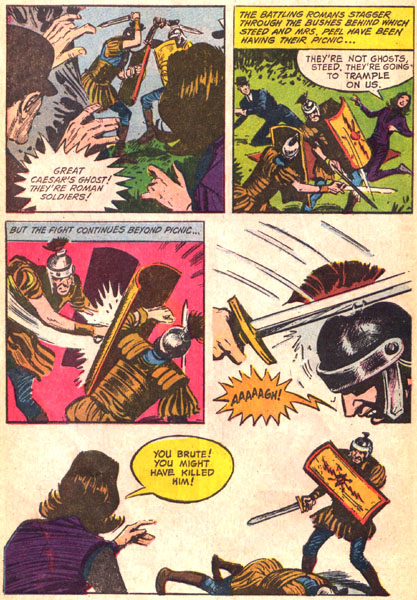
goldkey2.jpgIn an age where reprint across continents is big business, it's interesting to see just how much the US version of the Avengers strips were changed: while non-English speaking countries also carried out extensive 'surgery' to fit comics into their chosen format, I hadn't seen this level of reformatting in an English language reprint before, which included re-lettering and removal of some panels.

• For more on TV's Avengers comic incarnations visit: wingedavenger.theavengers.tv


(Article complied with thanks to Ian Phillips and Jeremy Briggs, for the Bear Alley link)

Wednesday, 20 May 2009

Fireball XL5 Special Edition DVD Announced

(Updated 22/5/09): Network DVD has announced a "Special Edition" release of one of Gerry Anderson’s most cherished fantasy series, Fireball XL5, next month - and released a clip from a colourized episode.

Available from 29th June 2009 this six-set - wrapped in a cover inspired by one of the series original annuals but spruced up with a CGI-enhanced Fireball XL5 -- includes all 39 episodes from the iconic 1960s series, complete and uncut, plus exclusive extras including a 60-page book by top British TV archivist Andrew Pixley.

Also included is Drawn in Supermarionation, a new, exclusive documentary chronicling the comic strip adaptations of the early AP Films series in TV Comic and TV Century 21, and features contributions from director of merchandising Keith Shackleton and artists Bill Mevin, Mike Noble and Colin Page.

Although the show was filmed in black and white, also in the set is A Day in the Life of a Space General, a brand new, colourised edition of Fireball XL5, taken from a new HD transfer of the original film elements.

The show is set between 2062 – 2063, the peace of the universe maintained by World Space Patrol’s finest rocket ship, the eponymous Fireball XL5. A brave, gallant crew led by the heroic Colonel Steve Zodiac - surely inspired by 1950s comic characters such as Dan Dare - explore various exotic planets and other life forms and protect the innocent from sinister intergalactic villains such as Mr. and Mrs. Space Spy.

The memorable crew comprises of the glamorous doctor Venus, middle-aged navigator and engineer Professor Matthew Matic and Zodiac’s co-pilot Robert the Robot, who was voiced by series creator Gerry Anderson himself.

This series harks back to a more innocent and naive age of space adventure: the series producers for example did away with the need of spacesuits by having the crew swallow 'oxygen pills' to move about their spacecraft. But it's still something of a classic and this edition looks pretty impressive!

• Buy Fireball XL5 - The Complete Series - Special Edition from amazon.co.ukBuy Fireball XL5 - The Complete Series - Special Edition from amazon.co.uk

Special Features Include:

• A Wonderland of Stardust: taking its name from a line in the show's theme tune, a brand new documentary about the making of Fireball XL5 featuring contributions from creators Gerry Anderson and Sylvia Anderson - a pretty remarkable feat! - as well as numerous members of the crew including David Elliott, Alan Pattillo and Brian Johnson


• A Day in the Life of a Space General: A brand new, colourised edition of Fireball XL5, taken from a new HD transfer of the original film elements

• Drawn in Supermarionation: This new, exclusive documentary chronicles the comic strip adaptations of the early AP Films series and features contributions from director of merchandising Keith Shackleton and artists Bill Mevin, Mike Noble and Colin Page.

• Bill Mevin’s Supercar Home Movie: Previously unseen footage filmed by TV Comic artist Bill Mevin during production on Gerry Anderson's earlier show, Supercar

• Zoom ice lolly commercials

• Image Galleries

• PDF Material and a 60-page book written by TV historian Andrew Pixley


• • Buy Fireball XL5 - The Complete Series - Special Edition from amazon.co.ukBuy Fireball XL5 - The Complete Series - Special Edition from amazon.co.uk

Sunday, 15 March 2009

Happy 50th Birthday, Mighty Moth!


(with thanks to "Ian"): The first appearance of Mighty Moth, the longest-running strip in Britain's TV Comic was in Issue 384, dated week ending 14th March 1959.

The strip ran every week until the title was cancelled in June 1984 and was the creation of Dick Millington, whose more recent credits include The Guinness Book of Records for the Mail on Sunday for 10 years and who still writes and draws the I Don't Believe It strip in the Daily Mail

Technically, of course, TV Comic Issue 384 would have been on on sale since the previous Monday (9th March), but for a strip that simply featured man versus moth every issue for some reason it stuck in my brain and was often great fun, as was Dick's other TV Comic work such as Basil Brush and The Moonbeams. He also wrote several strips including The Telegoons and edited TV Comic's stable mate title Pippin and drew Happy Famillies for Whizzer and Chips and Ray Presto for Krazy.

Mighty Moth also stuck in the mind of Alan Moore, apparently making a cameo in The Black Dossier (on Page 190).

"I wrote the stories and drew the entertainment for 16 years in the Sixties and Seventies, along with Basil Brush," Millington, who lives in Canterbury, confirmed in the Daily Mail in 2002 when asked if he was the Moth's creator by a reader. "My career in humour began in early youth when I was stooge to my dad, a semi-professional comedian ('don't give up the day job') whose stage name was Billy Jiggs.

"We were children's entertainers by day and on the working mens club circuit in London and Essex - an experience that has subdued better men than me.

"Unable to overcome stage-fright, I decided to retire from showbusiness and become a cartoonist - where, in a high- circulation newspapers like the Daily Mail one can reach a huge audience without them shouting back!"

Here at downthetubes we echo other fans who say "Here's to 50 more years swatting", but like many other great comics and strips, it's not to be.

The Mirror
's parent Trinity Mirror of course owns the rights to Mighty Moth and other non-licensed strips that featured in TV Comic.

• More TV Comic Highlights Here
• Dick Millington on Lambiek

Friday, 1 February 2008

Bill Mevin Interviewed on Time Meddler DVD

Perishers and TV Comic Doctor Who artist Bill Mevin is one of several comics creators interviewed on a special release of the Doctor Who story The Time Meddler, released 4 February in the UK.

This is the first of several "Stripped for Action" features which will feature on upcoming Doctor Who DVD releases. This documentary centres on the First Doctor's comic strip adventures which began in TV Comic and in addition to Mevin includes interviews with comics historians Jeremy Bentham and John Ainsworth and former Doctor Who Magazine editors Gary Russell and Alan Barnes. (Russell edited Marvel UK's Doctor Who Classic Comics, after John Freeman negotiated purchase of publishing rights for all the Doctor Who TV Comic strips on behalf of Marvel UK, with what was then owner London and North Surrey Newspapers, now owned by Trinity Mirror).

Bill Mevin, now 87, studied at Liverpool School of Art Before joining Gaumont British Studios as a trainee film animator, working on the 1954 animated film Animal Farm and various shorts. He then went on to work as a topical cartoonist for the Sunday Chronicle newspaper for six months, later working in children's comics for several years on characters that included a six-month stint on Doctor Who for TV Comic - a strip he remains proud of to this day - Popeye, Bugs Bunny, Yogi Bear, Space Patrol and many others.

He later created The Soapremes for the Daily Mail, a cartoon strip satirising American soaps Dallas and Dynasty, before going on to work on The Perishers for the Daily Mirror for over eleven years before its cancellation. You can view caricatures and other art by Mevin on The Authentic Perishers web site and read a more detailed profile of Bill's career on Bear Alley).

Every comics incarnation of the Doctor will feature in the "Stripped for Action" series which is being co-ordinated by acclaimed writer and publisher Marcus Hearn. Interviews for a Seventh Doctor segment, recorded this week in London include Paul Cornell, Lee Sullivan, Simon Furman, John Freeman and Andrew Cartmel.

The Time Meddler also features a commentary with actor Peter Purves, producer Verity Lambert, script editor Donald Tosh and designer Barry Newbery, plus production and publicity photos from the story.

• Buy The Time Meddler from amazon.co.uk

Latest News on downthetubes.net

Contact downthetubes

• Got a British Comics News Story? E-mail downthetubes!

• Publishers: please contact for information on where to post review copies and other materials: editor@downthetubes.net

•
Click here to subscribe to our RSS NewsFeed

Powered by  FeedBurner