downthetubes is undergoing some main site refurbishment...

This blog is no longer being updated

The downthetubes news blog was assimilated into our main site back in 2013.

Hop over to www.downthetubes.net for other British comics news, comic creating guides, interviews and much more!
Showing posts sorted by relevance for query Cinebook. Sort by date Show all posts

Saturday, 17 December 2011

In Review: Cinebook Recounts The Wright Brothers

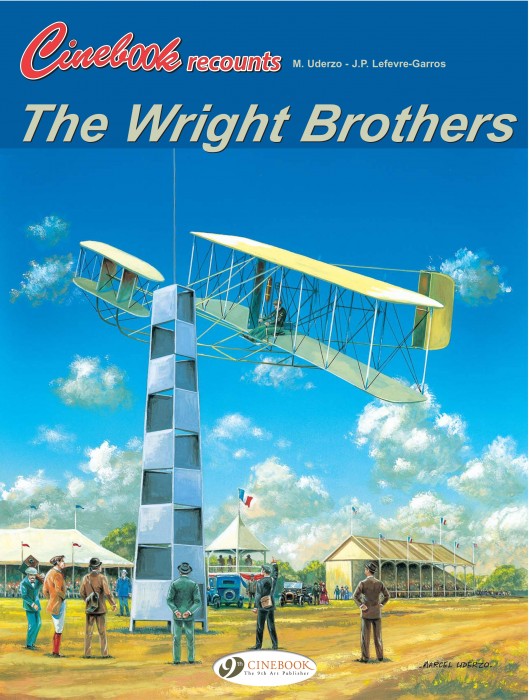
Cinebook return to their historically factual series Cinebook Recounts with the story of the first manned flight of a powered aeroplane at Kitty Hawk in America in 1903 with The Wright Brothers, written by J P Lefevre-Garros and illustrated by Marcel Uderzo.

Engineers Orville and Wilbur Wright had made their money printing newspapers in Daytona, Ohio and, by the turn of the twentieth century, had moved on to manufacturing the new craze of the day, bicycles. However their real desire was to fly and leaving their sister in charge of the bicycle business they used the winters to travel to the sand dunes of Kitty Hawk, North Carolina, were they flew firstly large kites before moving on to gliders. With the experience of designing and flying the gliders, their next task was to design a light but powerful engine that they could fit to their aircraft to power it. But they were not the only engineers around the world with similar plans.

This book has a bit of tortuous history. It was originally published in Europe as Biggles Raconte Les Frères Wright in 2005, part of a series of factual aviation history books themed around WE John's pilot character but not actually featuring Biggles himself. Cinebook managed to release two of the books from this series, Biggles Recounts The Falklands War and Biggles Recounts The Battle Of Britain, in 2007 and 2008 with Biggles Recounts The Wright Brothers due for 2009 but issues arose between the estate of WE Johns and Lombard, the original French publishers. This lead to Lombard loosing their Biggles licence, meaning that Cinebook could no longer release any Biggles titles. While this stymied further releases in their fictional Biggles series, as the character was not in the factual series they retitled it as Cinebook Recounts and started again.

With Battle of Britain and The Falklands War rereleased under the new series title, The Wright Brothers is the first of the "new" Recounts books, albeit with an English translation dating from 2008.

This was originally the sixth book in the Biggles Raconte series and by this point the French series had covered mainly war topics with their inherent action and adventure, so the tale of two engineers who designed big kites and then incrementally modified their designs until they reached a controllable, manned aircraft was a change of pace. This is not a dull book by any means but readers expecting a tale of adventure and daring pilots will be disappointed. Lefevre-Garros gives the background to the brothers work, setting the historical scene by mentioning some of the other people working towards manned flight at the time and even suggesting in the second panel of the book that a Frenchman beat them to it (Clement Ader did just struggle into the air in 1897 but it was an uncontrolled hop). While many others appear to have started by jumping in the deep end and building a powered aircraft that they didn't know how to fly, the Wrights started with kites to learn aerodynamics and then moved on to gliders so that they knew how to control an aircraft in flight before finally progressing to a powered aeroplane.

Backed up by Marcel Uderzo's detailed and accurate artwork, Lefevre-Garros takes the reader through the years of test flying the kites and gliders and the Wrights' redesigns on them as they found the weaknesses of each stage of their development before reaching the morning of 17 December 1903 when Orville Wright lay down in the pilot's position of the aircraft they simply called Flyer but we now refer to as Wright Flyer 1, turned the engine on and literally flew into the history books.

Cinebook Recounts The Wright Brothers is not an action packed tale of daring pilots but it is a detailed and well illustrated account of the logical design steps of two engineers that lead up to a moment in history - and that is what makes it worth reading.

There are more details of Cinebook Recounts The Wright Brothers and the other titles in the Cinebook Recounts series on the Cinebook website.

There are more details of the original French Biggles Raconte books on the International Biggles Association
website.

Saturday, 18 June 2011

XIII Questions About Cinebook's XIII

Cinebook began publishing English translations of Franco-Belgian bandes dessinee graphic novels in 2005 and, with well over 100 titles now available, have succeeded in bringing many characters familiar to European audiences to the English speaking world either for the first time with series such as Clifton and Orbital or with multiple releases of series that had previously only had a few books translated like Lucky Luke and Thorgal.

One of the series that falls into this second category is the spy/mystery series XIII from writer Jean Van Hamme and illustrator William Vance which had only previously had the first three of its nineteen albums translated by both CatCom and Marvel in the US. downthetubes' Jeremy Briggs talked to Cinebook publisher Olivier Cadic and XIII translator Jerome Saincantin about the series.


DTT: XIII began in issue 2408 of Spirou magazine in 1984 before being complied into the first album Le jour du soleil noir (The Day Of The Black Sun). When did you both first come across the series?

Jerome Saincantin: XIII was one of the few comics that my father wasn’t buying religiously back then, so my first contact must have been around 13 or 14, when I began going to the local library after school – mostly because I’d run out of new stuff at home! I remember liking it a lot for the “real world” feel it had, something I’d only found in Yoko Tsuno thus far. But XIII was a lot grittier than Yoko, or the other BDs I was used to – Asterix, Achille Talon, Lucky Luke or even Valerian. While I always enjoyed reading it when I could, for a long time it remained a series I’d catch up on at the library or through my friends. It’s a problem – you can’t buy everything!

Olivier Cadic: It was our readers who asked me to publish XIII. I’d never read it back then.

DTT: What do you think sets XIII apart from other spy or mystery series?

Jerome: Well, the obvious answer is its quality. The art is consistently fantastic and didn’t lose anything over the years; and Jean Van Hamme really IS a master storyteller – it’s not just a sales pitch! He can weave suspense, action, humour and a great deal of plot seamlessly into a single story, and there’ll be something for everyone and no one will feel left out – that’s an incredible talent, right there. Not to mention the plot is actually intelligent and consistent. There are many other spy/mystery series available, some of them quite brilliant; but I don’t think any of them have that broad an appeal. Plus, at least for me, it was the ORIGINAL spy/mystery series. The very first! Maybe older readers would have a different take, of course, but as far as I’m concerned, new series get compared to XIII. It’s the reference.

Olivier: The outstanding quality of Van Hamme’s storytelling, combined to Vance’s unique art style.

DTT: Was the fact that the first three albums had previously been published in English in the States an issue in deciding to publish XIII?

Olivier: We had published other series by Jean Van Hamme - such as Thorgal, Largo Winch and Lady S. At first, readers believed that, like all other publishers before, we’d give up quickly. But seeing that we were in fact successful, they began asking us, week after week, to publish XIII. They were very frustrated at having only the first three volumes available. That’s what convinced the French publisher and the authors to sell us the rights.

DTT: The first story arc runs through the first five XIII books. Are there similar story arcs throughout the rest of the series?

Olivier: Buy your XIII book every two months to get the answer. ;-)

DTT: Rather than pause at the end of each series story arc, the Cinebook plan for XIII then is to publish the nineteen books of the series at the rate of one every two months over the course of 3 years to be completed in, appropriately enough, 2013. The only other Cinebook series to get the same speedy releases is the very popular Lucky Luke. Was this ambitious schedule part of your original plan when you were looking to license the series for English publication?

Olivier (left): One visitor at the Bristol Comics Expo had told me: “Never try to publish XIII. It’s cursed. No publisher’s ever gone past volume three.” My answer had been: “If Cinebook publishes XIII, it’ll be blessed.” So, when we got the opportunity to negotiate for the rights, I decided to show both authors and readers that it was Cinebook’s calling to let them find each other. The readers had awaited the rest of the series for too long. We wanted to present all those who believed in Cinebook, and had been waiting to discover the entirety of XIII, with a gift. To do that, it was necessary to let them know when the end would be published—so they’d know for sure that we intended to go the distance. The authors loved my idea: everyone will know who XIII is in 2013!

DTT: Have you had any feed back from writer Jean Van Hamme or artist William Vance about the Cinebook versions?

Jerome: I haven’t met William Vance, though I hope I get the chance at some point. I did meet Jean Van Hamme at Angoulème this year. He’s a bit of a formidable character! The man is quite nice, but he also has a no-nonsense, I-have-paid-my-dues-and-will-not-take-any-crap attitude that discourages the lowly translator from asking outright if he’s happy with the work done! I was afraid I might get eaten, you know! Joking, of course. He’s not an ogre! It’s just that I’m still in the “I can’t believe I’m working in this field” phase and am easily intimidated by celebrities! As far as I know, he has made no complaints about our translating work – and he does speak English. So I’ll take this as an endorsement!

Olivier: Jean Van Hamme came to London for the launch of XIII by Cinebook. We’d organised the launch in a club at midnight. I’d told our distributor that, exceptionally, Big Ben would strike thirteen times. They believed me - and luckily enough, no one went and checked!

DTT: The work of a translator, like that of a letterer, is often taken for granted - a good translation passes unnoticed but a poor translation is very obvious. The translation of XIII is so natural that it feels as if it was originally written in English. Did you find the series easy to translate in comparison to other albums or books that you have worked on?

Jerome (right in white with Orbital artist Serge Pelle): It’s important to note, first, that I’m the PRIMARY translator for this series and several others – but that every translation job is team work. I translate; the first draft is looked over by a first person in the UK for easy mistakes, then corrected by a professional proofreader in the US. It goes back to me, and back and forth as needed until we’ve reached a consensus on everything. Then it’s re-read yet again by a couple of fans in the UK for a fresh look. I think that’s one of the reasons for Cinebook’s success – from the beginning, Olivier decided to do things properly, not half-baked. So, thank you very much indeed for the compliment! But I will accept it on behalf of the whole team, not just me!

Now, about the actual question here - XIII is indeed one of the easier series to translate. I’m naturally at ease with fluid, familiar register dialogue, especially in “American,” and years of reading Tom Clancy and Stephen Coonts novels have given me a passing familiarity with the worlds of military and intelligence. The most difficult sometimes was to stick to the age limit, especially in SPADS – snippets of Full Metal Jacket and Heartbreak Ridge kept pushing their way into the dialogue, stuff that made even me blush!

In comparison, some series are difficult, or bordering on the nightmarish. Long John Silver is an absolute joy, but requires extensive research into period speech and naval vocabulary; The Bellybuttons had me delve into whatever language teenagers find “hip” these days which wasn’t always easy. And of course, there’s our collective bogeyman: Blake and Mortimer… Whole slabs of very formal, very British, 50’s text… Sometimes, when I’m working on B&M, at night, I curl up and cry… :p

DTT: How far ahead of the publishing schedule are your translations and how long on average does it take you to translate a book?

Jerome: I’m currently working on the September/October batch, for example. So I’d say 3 or 4 months in advance. The publishing side of things isn’t my department, so mostly I translate when I’m told! Speed of translation varies widely, depending on my schedule, on how inspired I feel by the comic at the time, and of course on difficulty and research needed. On average, though, I’d say it takes about a week of actual work to produce a proper first draft, then maybe another week or two of back and forth for an almost-final version. Last typo-catching sessions can still take place a lot later. That’s for normal comics of course. Blake and Mortimer, now… *shudder*

DTT: Since Jerome is not credited as the translator in the Cinebook versions of the first three books, did the Cinebook versions use the previously published translations those three books?

Olivier: Erica worked from Catcom’s version.

Jerome: Yes; the texts were given to Erica, our American proofreader, first, to check the language; then I was asked to read them to make sure there wouldn’t be any conflicts with the following volumes – on choices of names, for example, or the meaning of acronyms (SPADS), etc…

DTT: XIII Book 1: The Day Of The Black Sun was available free with issue 5 of Comic Heroes magazine. How did this come about?

Olivier: They contacted us and came with this great idea. I love great ideas!

DTT: The original covers that the XIII albums were published with have been updated with new illustrations by William Vance and Cinebook are using the new versions. Was there an option to use either the old or new covers or does original publisher Dargaud prefer that all foreign editions standardise on the current French covers?

Olivier: We use most of the new covers. We were free to decide which one we preferred.

DTT: There are French live action TV series and films of many of the Cinebook titles including Largo Winch and Iznogoud while XIII was made into a mini-series XIII: The Conspiracy in 2008 starring Val Kilmer and Stephen Dorff and broadcast in the UK on channel Five. Have either of you seen it and is it any good?

Jerome: I must confess I haven’t watched it yet. Not out of doubt as to its quality, but because I don’t want to muddle my own (and by now, established) “sound” of what XIII is like with the movie’s take on it. I also have a backlog of DVDs to watch that’s bordering on the ridiculous!

Olivier: The Largo Winch movie is really great. The special effects are worthy of the effort, and our blue-jeans wearing hero was perfectly cast. The Iznogoud movie didn’t fare quite as well. It takes enormous talent to adapt Goscinny’s humour. But the fans can see their heroes ‘live’, and that’s always nice. I found the XIII mini series with Val Kilmer and Stephen Dorff really outstanding. I’m not surprised NBC decided to broadcast it twice, a year apart, in the USA.

DTT: The main XIII series concluded with the nineteenth book however there is a sister series entitled XIII Mysteries currently running to three books and a 20th main series title due later this year in France, all of which have been produced by different creative teams. Could you tell us a little about these and if Cinebook might consider translating them in the future?

Jerome: Well, as far as publishing it, I cannot tell. Regarding the spin-off XIII Mysteries, I haven’t looked at it yet. I’ve lived in Ireland for ten years, a country where finding comics – especially European BDs – is akin to looking for snow in the Serengeti. I’ve been back in France for a year, but the backlog of comics I missed, and sometimes didn’t even hear about, is quite extensive. I’ll get to it eventually! As for volume 20, I just heard about it, and I’m very much looking forward to it! Youri Jigounov is an excellent artist who should be a good successor to William Vance. And I want to know what’ll happen to XIII – he’s a bit of a personal friend by now!

Olivier: The XIII Mysteries series is a massive success and I found the books really great. There’s every chance we’ll include them in our schedule for 2014 onward.

DTT: Olivier and Jerome, thank-you both for your time.

Jerome: Thank you kindly.

Olivier: Thank you!

There are more details of the English language XIII titles at the Cinebook website.

There are more details of the original French language XIII titles at the official XIII
website (in French).

Monday, 10 May 2010

In Review: Cinebook Recounts The Battle Of Britain

Cinebook Recounts The Battle Of BritainIf you are looking at the cover of Cinebook Recounts The Battle Of Britain thinking that it looks a little familiar that is because this is the third time that it has been published in the UK. The first time was by Red Fox in 1995 while Cinebook themselves published it in 2008 - but in 1995 it was entitled Biggles And The Battle Of Britain while in 2008 it was Biggles Recounts The Battle Of Britain. With there being an issue between the original French publishers and the WE Johns estate over the character of Biggles, we should probably consider ourselves lucky that, since he is not actually a character in the story, it was relatively easy to retitle the book and avoid the issue.

First and foremost this is a history book, which relates the events of that summer 70 years ago when the Luftwaffe attempted to wrestle air superiority of the southern English skies from the Royal Air Force to allow an invasion fleet to sail from German occupied France. They were unsuccessful and Hitler moved on to open up a second front against the Russians instead.

Written by Bernard Asso and illustrated by Francis Bergese, the book relates the story of the battle in 22 pages which is then followed by 20 pages entitled The Bombing Of Germany (1943 - 1945). Asso tells the story briefly but succinctly including many of the characters from both the British and German sides to humanise the story although in translation from French to English Air Vice Marshal Leigh-Mallory looses part of his rank which also happens to German Grand Admiral Raeder who's surname is also mis-spelt.

Unfortunately, it is not the only issue since the problems begin right in the first panel in which we are told that the British Expeditionary Corps were evacuated from Dunkirk - it was the British Expeditionary Force. This tends to show that the original French version has been translated too literally into English without checking the correct British terms so, for instance, the twin engined Messerschmidt Bf110 fighters are described as "bi-motor".

For a fictional story the odd instance of this can be forgiven: however, in a factual book such terms should be correct and all too often in the Battle of Britain story they are not. The other mistake in that first panel is one that Cinebook have made before in Biggles - Spitfire Parade, referring to the British World War 2 military who fought for King George VI as 'her majesty's forces'. The lack of knowledge of RAF terms also seen in Spitfire Parade is also evident here, with inaccuracies as to how squadrons and groups are numbered.

As with Spitfire Parade, this book really needed a proof reader familiar with the subject.

The second half of the book is given over to the allied bombing campaign in Europe in the later stages of the war. This does not suffer in translation the same way as the Battle Of Britain section does, perhaps because it has fewer specific terms in the text, but it does get the Cinebook censorship treatment on the "good girl" art that adorned the aircraft. Strangely, this is a little inconsistent with the female figures only being removed in close shots while if the same aircraft is smaller in the next panel the figure remains.

Yet for all these issues Bergese's artwork remains a delight. His aircraft are accurate and detailed, even down to the mud splatters from the Hurricane tail wheels appearing on their rear fuselages, and he is as good at illustrating bombers as he is with fighters, be they German, British or American.

This is a reissue of one of the earliest Cinebook publications, which may explain away a little of the dodgy translation but for those into their aircraft then it must be bought to see Bergese's excellent artwork.

• There are more details of the Cinebook Recounts series on the Cinebook website.

• There are more details of the original French Biggles Raconte series on the International Biggles Association website.

Monday, 6 December 2010

Cinebook Release Their January-June 2011 Schedule

Cinebook , the Canterbury-based publisher of European bandes dessinee albums translated into English, have released a PDF copy of their first 2011 catalogue onto their website.

In the six months between January and June 2011 the company will publish 20 new titles, the vast majority of which have never been translated into English before.

The twin backbones of the Cinebook range are the humorous Lucky Luke books and the espionage thriller XIII. Each of these series are published at a rate of one every two months with the XIII books now well beyond any previous English language publication, while the Lucky Luke series will have reached the 29th book by June. As well as more Blake and Mortimer and Largo Winch titles are the third Bellybuttons book and Cinebook finally returns to Orbital with the third title in the SF action series.

The headline piece from the catalogue is that Cinebook will be publishing one Jean Van Hamme book each month. Van Hamme's titles range from the modern Blake and Mortimer stories, via Lady S and Thorgal to the aforementioned Largo Winch and XIII. June will see a one off special by Van Hamme along with his Thorgal artist Grzegorz Rosinski entitled Western and set in Wyoming in 1868.

With the Christmas buying season being somewhat curtailed by the current snow perhaps it is worth letting the postman do all the hard work and order up a title or two that you have not yet tried. If you like Tintin and Rainbow Orchid then try Blake and Mortimer or if you like Modesty Blaise try Lady S. If Nemi in the Metro newspaper is more to your taste then it would be The Bellybuttons, if it is James Bond you prefer then try Largo Winch, while if the kids like Harry Potter then try Scared To Death.

Reviews if the current batch of Cinebook releases including their two new series, Crusade and Long John Silver, will appear on downthetubes soon.

• Download the Cinebook catalogue (PDF)

• There are more details of all Cinebook titles on their website.

Monday, 17 May 2010

Cinebook Announces Titles For Late 2010

Cinebook, the Canterbury based publisher of translated Franco-Belgian graphic novels, have released their catalogue for the second half of 2010 and it includes new series that haven't been translated into English before.

These new series are Long John Silver, written by Xavier Dorison with art by Mathieu Lauffrey, and Crusade, written by Jean Dufaux with art by Phillippe Xavier. Long John Silver is, as you would expect, a sequel to Robert Louis Stephenson's novel Treasure Island set 20 years later while Crusade is a supernatural tale set in the middle ages during a forgotten crusade to the Holy Land. The first Crusade title is Simoun Dja and will be released in October while the first Long John Silver title is Lady Vivian Hastings and it is released in November. Both series are rated 15+ by Cinebook.

The first book in the contemporary thriller XIII series, The Day Of The Black Sun, written by Jean Van Hamme with art by William Vance, is due to be published in May and the new catalogue shows that they will continue to be published at a rate of one book every other month. The series runs to 19 albums and while the first three have previously been translated into English and published in America, Cinebook intend to publish the complete set with the fourth book, SPADS, due in November 2010, the first time that it will have been published in English.

The other big series that Cinebook are be starting is Valerian and Laureline. This is one of the best known and highly regarded Franco-Belgian science-fiction series running to 23 albums. Written by Pierre Christin with art by Jean-Claude Mezieres, the books tell the stories of two spatio-temporal agents, the 28th century born Valerian and his female companion Laureline who comes from the Middle Ages. With both spacecraft and time machines available to them the series has the same potential as Doctor Who for a vast range of settings.

The Valerian and Laureline books have had sporadic English language releases before with the only UK publications being four books published by Hodder-Dargaud in the mid-1980s. Cinebook will be starting with The City Of Shifting Waters which is the first book in the French series although, confusingly, there is a prequel 'Book Zero' that was published afterwards. While the story originally began in Pilote magazine in November 1967 this will be the first time that this particular story has been published in English and Cinebook are releasing it in July.

More details of each series are available on the Cinebook website where the new catalogue is available as a PDF download.

Friday, 26 June 2009

In Review: Biggles - Spitfire Parade

James Bigglesworth, popularly known as Biggles, is one of those fictional characters that has entered the British public consciousness whether or not they have read any of the novels or short stories written by Captain WE Johns. The first Biggles book, The Camels are ComingBiggles: The Camels are Coming, was published in 1932 in which he was a World War 1 pilot in the Royal Flying Corps and he would progress through various jobs and adventures in the inter-war years before returning to once again defend the country from the Germans during World War Two despite having barely aged along the way.

Spitfire Parade was published as a hardback collection of thirteen related short stories in August 1941 when the imminent invasion of Britain had receded but King, Country and Empire still stood alone against the Nazi war machine. It tells the ongoing story of Biggles taking charge of the fictional Royal Air Force 666 Squadron in Summer 1940 and building a disparate group of pilots into a fighting team. Operating Spitfire fighters, they take on the Luftwaffe fighters and bombers as well as trying their best to outdo the neighbouring Hurricane fighter squadron.

This is an often tongue-in-cheek and unashamedly pro-British story which is only to be expected considering the book was written for children in the darkest days of the war. All but one of the RAF pilots return unscathed to their base no matter what happens to their planes whilst the Luftwaffe aircraft crash and burn.

In the Cinebook graphic novel of Spitfire ParadeSpitfire Parade, writer and artist Francis Bergese adapts around half of Johns' original short stories into 52 pages of comic strip that was originally published in France by Claude Lefrancq Editeur as Le Bal Des Spitfire in 1992. The comic strip story moves quickly without appearing to skip much of its source material while Bergese's art is clear and accurate despite the large number of aircraft types he has to illustrate - Spitfire, Hurricane, Blenheim and Tiger Moth on the RAF side and Messerschmitt Bf 109 and Bf 110, Junkers Ju88, Heinkel He111 as well as the inevitable Stuka on the German. He even manages to get a Matilda tank in on the action as well.

Bergese’s accuracy even extends to the British military serial numbers of the RAF aircraft. Most of the aircraft serial numbers are readable and, considering that most artists would ignore them or simply make them up, he uses serial numbers that are historically accurate for the types of RAF aircraft involved. While that might be totally irrelevant to the vast majority of the book’s readers, it shows an impressive dedication to accuracy by the artist.

British publications of Biggles graphic novels have been sporadic over the years but date back to artist Pat Williams' 1955 hardback "Biggles strip book" adaptation of the 1933 novel Cruise Of The Condor, while Hodder & Stoughton published various translated Swedish Biggles albums by Bjorn Karlstrom in the late 1970s and early 1980s. This is not the first time that this particular bande dessinee album has been published in the UK, the previous edition being published by Random House’s Red Fox imprint in 1993, but the Cinebook version is a new translation by Luke Spear.

This does beggar a comparison between the two translations and while the Cinebook version probably remains more faithful to the original French text, it does feel a little clunky in comparison to the more naturalistic translation by Adam Robson in the Red Fox version. A few differences between the two do occur, such as Flying Officer George Ferris being from Liverpool in the Red Fox version while the Cinebook version has him from Wales - but the biggest change is in the nickname used by the characters when referring to the Germans. The Red Fox version calls them "Huns" and is at pains to point out in an editorial note that this is used in a familiar rather than a derogatory sense(!), while the Cinebook version goes uses a wider variety of nicknames although they do retain "Hun" as well. However parents considering giving this book to younger children should be aware that Cinebook have included “bastard” as a description of one of the German pilots.

The Cinebook translation also tends to show a lack of RAF knowledge with Coastal Command being referred to as “the Coastal Command” and the squadron’s A Flight and B Flight being renamed the distinctly un-RAF Flight A and Flight B. At one point a Spitfire is described as belonging to Her Majesty's Government, however the biggest clanger is their description of one of the RAF pilots ejecting from a Spitfire, years before ejector seats were fitted to British aircraft. The Red Fox version more accurately described the pilot as having bailed out, as shown in the artwork.

Despite this, Spitfire Parade is a bright, often funny, boy's-own romp through English wartime skies. Just don't expect this to be a war story along the lines of Darkie's Mob or Charley's War - it is still Biggles after all.

• Spitfire Parade is the latest Biggles graphic novel to be published in the UK. The first UK Biggles graphic novel was Cruise of the Condor in 1955 and you can read Jeremy's review of it on Steve Holland's Bear Alley.

• More details of Biggles - Spitfire Parade can be found on the Cinebook website

• More details of foreign language Biggles albums that have been published in English can be found on the Euro Comics translations website.

• All the foreign language Biggles editions in print are available from the International Biggles Association Online Shop

Saturday, 7 May 2011

Cinebook Release Their Summer/Autumn 2011 Catalogue

The Canterbury based graphic novel publisher Cinebook have just released their catalogue for the second half of 2011 and it shows their continued dedication to bringing previously untranslated Franco-Belgian bandes dessinees albums to the English speaking world with an impressive selection of titles.

The twin backbones of Cinebook's releases continue to be the bimonthly releases of both the humorous Lucky Luke titles, written by Rene Goscinny and illustrated by Morris, and the XIII adventure titles, by writer Jean Van Hamme and artist William Vance. By the end of 2011, Cinebook will have published 10 of the by then 20 XIII albums and 32 of the 76 Lucky Luke albums - taking both series far beyond any previously published English language translations by other companies.

In addition they will continue publishing the new series Long John Silver and Crusade as well as returning to older favourites like Lady S and Thorgal. The Recounts aviation documentary series continues with Cinebook Recounts The Wright Brothers, a title previously scheduled in January 2009 as Biggles Recounts The Wright Brothers but which got cancelled due to events between the estate of WE Johns and the original French publisher that were beyond Cinebook's control.

Science fiction titles are also coming to the fore again with more Orbital and Valerian books as well as a return to the Worlds of Aldebaran series by Leo. Having published all five of the Aldebaran cycle from this series followed by all five of the Betelgeuse cycle, October will see the beginning of the Antares cycle.

Perhaps the most intriguing of the new titles will be Darwin's Diaries, the first book of which will be published in September and which has the police asking the famous naturalist to investigate a crime that may involve a legendary creature.

• Cinebook will be attending the Bristol International Comic Expo next weekend, 14/15 May 2011, and their latest catalogue is available as a PDF download from their website.

• Lucky Luke Books on amazon.co.uk

• XIII Books on amazon.co.uk

• Lady S Graphic Novels on amazon.co.uk

• Thorgal Books on amazon.co.uk

• Long John Silver Graphic Novels on amazon.co.uk

Tuesday, 6 July 2010

In Review: The Scorpion - The Holy Valley

Adventurer, womaniser, swordsman, thief, swindler, arrogantly self assured of his own survival, with blood ties to one of the most important people on the planet, and a woman whom he both hates and desires, and who appears to reciprocate those same feelings back at him - The Scorpion could quite easily be 2000AD's Nikolai Dante. Yet there is one big difference - instead of being set in the 27th century, The Scorpion is set in the 18th century.

In the Vatican the old Pope has been murdered and Cardinal Trebaldi, the Prefect for the Propagation of the Faith, which he propagates with warrior monks, has been elected in his place after showing the other Cardinals in the Conclave what he claims to be the true Cross of Saint Peter, the first Pope. Yet there is more to the deceit since the new Pope does not believe in God and is considerably more Roman than Catholic. The Scorpion is on a quest to find the true Cross of St Peter, a quest that takes him, his sidekick, a former Hussar, and the beautifully dangerous Egyptian woman, Mejai, to Cappadocia pursued by the leader of Tebaldi's warrior monks Rochnan and the new Pope's own treasure hunter, Ansea Latal.

The Holy Valley is reminiscent of Indiana Jones And The Last Crusade with the Scorpion treasure hunting up an enclosed valley for a religious artifact hotly pursued by those who want the treasure for more nefarious means, yet to suggest the connection almost does the book an injustice. Written by Stephen Desberg, The Scorpion is a major departure from his other Cinebook series, IR$, which is built around international banking intrigue. The Scorpion is an historical swash buckling adventure with a dizzying array of double and triple crosses as the story progresses. Indeed the only person that the Scorpion seems to be able to trust thus far is Hussar.

The artist for the series is Enrico Marini who doesn't feature in any other Cinebook series which is a pity because of all the adventure artists that Cinebook publish Marini is my favourite. From his well defined and charismatic characters to his scene setting panels with their unusual angles, from the dynamism of his fight scenes to his use of colour, The Scorpion books look sumptuous whether the action is set inside the opulence of the Vatican or in an arid sun baked valley. I would certainly like to see Cinebook publish other series with Marini's art.

So is there a drawback? Sort of because The Scorpion isn't a series, it is a serial. The Holy Valley is the third English language Scorpion book which translates La Vallee Sacree, the fifth French language album originally published in 2004. Now since the previous two Cinebook titles, The Devil's Mark and The Devil In The Vatican, were both double length books no albums have been missed but you shouldn't really miss out on them either otherwise you will have missed a big chunk of the story, despite the short textual update at the start of each book.

The Scorpion is great fun, a well written and beautifully illustrated series that deserves to be read from the beginning and you will appreciate The Holy Valley much more for doing so. If you like Nikolai Dante, you should try it.

There are more details of The Scorpion books on the Cinebook website.

There are more details of the French Scorpion books on the Le Scorpion website (in French).

The next Scorpion book, The Treasure Of The Templars, is due to be published by Cinebook in August 2010.

Tuesday, 24 May 2011

In Review: Aldebaran - The Catastrophe, The Group and The Creature

Aldebaran: The Catastrophe published by Cinebook was one of the very first reviews that I did on downthetubes some two years ago. It published the first two French albums of the Aldebaran segment of The Worlds Of Aldebaran series in English for the first time. Since then Cinebook have completed both the five album Aldebaran arc as well as the five album Betelgeuse arc and will begin to publish the third arc, Antares, beginning in October 2011. Written, illustrated and coloured by the Leo (Luiz Eduardo de Oliveira) these series are set on human colony worlds in the 22nd century and follow the experiences of the colonists as they come to terms with the other life forms that inhabit those planets.

The story of Aldebaran is told through the eyes of teenage fisherman Mark Sorensen who, along with Kim Keller, the younger sister of a friend, is orphaned when his village is freakishly destroyed, a destruction the pair are lead to believe was caused by a dangerous and previously unknown sea creature. Helped and/or hindered by the journalist Gwen Lopes, biologist Driss Shediac, escaped prisoner Alexa Komarova and the scheming Mr Pad, Mark and Kim travel along the coast from their small outlying fishing village towards the planet's capital city Anatolia where they hope to find work and a new life. Instead they run foul of the authorities and end up imprisoned. The Catastrophe ends here after a long and fantastical journey for the two companions.

The Group begins three years later with Mark in prison and Kim older and rather more streetwise and less impetuous than her younger self. The story takes something of a twist here as we discover just how strict the planet's authorities are and just about every character that survived the previous book makes a reappearance as Mark escapes from prison and he and Kim go on the run, abetted by the now disillusioned journalist Gwen, as everyone tries to discover where and just who Alexa and Driss are and how they seem to know so much about the sea creature that destroyed Mark and Kim's village.

The Creature brings the saga of Aldebaran to a conclusion and the reader discovers much more about the creature as Mark and Kim's group vie with the authorities to understand the sea creature and discover the reason that Aldebaran has been cut off from Earth for a century.

Leo weaves a story that initially seems to be setting off in one direction but which takes a twist amost halfway through that raises the interest level considerably. What begins as a simple quest storyline for the truth about the sea creature also becomes a rebellion against the state.

These are thoughtful books covering the themes of coexistence with nature, totalitarianism and, to a lesser extent, sexism. Indeed as Leo grew up under a military dictatorship in Brazil, a country with an enormous coastline as well as the huge Amazon river basin, and considerably more wilderness than civilisation, you can see where the ideas and themes of his Aldebaran story come from. Indeed the books often feature long sections of discussion between the characters as they argue out these themes amongst themselves.

Yet for all the slower talky sections it is all held together by Leo's remarkable alien flora and fauna. From the enormous but docile flying Caravelle to the dangerous but immobile Eleuter, from the beautiful Gregorias (below) to the startling Amedea, the creatures and the environments that they inhabit are truly remarkable and the reader is often left both fascinated and repulsed by them.

If you are after fast moving, shot-em-up SF then try Cinebook's Orbital since the Aldebaran books will not be for you. However for a thoughtful if, at times, perplexing and talky story set in a gloriously alien world then Aldebaran is both a planet and a series worth sticking with and exploring to the end. Just remember that with this series, determination pays dividends.


The Worlds Of Aldebaran books were originally published by Cinebook as two French albums per English book before being standardised to the current one album per book, with the first Betelgeuse album being published in the third Aldebaran book before the Cinebook series changed titles.

The following is a listing of which French albums appear in which English books.

• Aldebaran 1: La Catastrophe printed in
Aldebaran Volume 1: The CatastropheAldebaran Volume 1: The Catastrophe
• Aldebaran 2: La Blonde printed in
Aldebaran Volume 1: The CatastropheAldebaran Volume 1: The Catastrophe
• Aldebaran 3: La Photo printed in
Aldebaran Volume 2: The GroupAldebaran Volume 2: The Group
• Aldebaran 4: Le Groupe printed in
Aldebaran Volume 2: The GroupAldebaran Volume 2: The Group
• Aldebaran 5: La Créature printed in
Aldebaran Volume 3: The CreatureAldebaran Volume 3: The Creature
• Betelgeuse 1: La Planète printed in
Aldebaran Volume 3: The CreatureAldebaran Volume 3: The Creature

• Betelgeuse 2: Les Survivants printed in
Betelgeuse Volume 1: The SurvivorsBetelgeuse Volume 4: The Survivors
• Betelgeuse 3: L'Expédition printed in
Betelgeuse Volume 1: The SurvivorsBetelgeuse Volume 4: The Survivors
• Betelgeuse 4: Les Cavernes printed in
Betelgeuse Voume 2: The Caves
• Betelgeuse 5: L'Autre printed in
Betelgeuse Volume 3: The Other

• Buy the Worlds of Alderbaran books on amazon.co.uk

• Details of all the Cinebook versions of the Aldebaran and Betelgeuse books are on the Cinebook
website.

• There are more details of all the original albums (in French) on the official Worlds of Aldebaran
website.

Latest News on downthetubes.net

Contact downthetubes

• Got a British Comics News Story? E-mail downthetubes!

• Publishers: please contact for information on where to post review copies and other materials: editor@downthetubes.net

•
Click here to subscribe to our RSS NewsFeed

Powered by  FeedBurner