Tom Humberstone is a cartoonist and editor. As the man behind such comics as Art School Scum, My Fellow Americans and the Eagle Award-winning How To Date A Girl In 10 Days, he's had critical plaudits aplenty. In this interview, conducted by Matthew Badham, Tom talks about making comics, his frustrations with art school -- and editing Solipsistic Pop, an anthology of new comics talent.
downthetubes: How did you get involved in the small press/self-publishing?
Tom Humberstone: I started making comics in my second year of art college when I became disillusioned with some of my peers and frustrated with the few seconds of animation I was producing each week despite extremely long hours in the studio. To me, making a comic was a wonderful exercise in instant gratification. Which, as time has gone by and I attempt more ambitious work, seems laughably naive in retrospect.
Regardless, I started photocopying these vicious little character assassinations called
Art School Scum on the way into college and plastered them throughout the halls. I loved having complete control of the content from start to finish and not having to compromise at any stage due to finances or time constraints. It felt quite punk. Needing only a pen, some paper, and about 20p for the photocopier.
Every fortnight, I'd cover the college walls with a new edition, targeting a different art school archetype under the alias of
Ventedspleen. It was only much later - sometime late in my third year - that I even considered collecting them in a book. It was later still - maybe even a year after graduating - that a friend managed to convince me to take my comics to a comic show and attempt to sell them.
My relationship with comics and the small press continued to be an on/off hobby for a few years until about two years ago when I started to really commit to publishing regular comics and attending more shows.
downthetubes: How do you make your living, from your art or in other ways?
Tom: While I don't tend to lose money on my comics - in fact, more often than not, I make a tiny profit - I can't rely entirely on them to pay rent, bills and all the other necessary monthly expenses. I have a full-time graphic design job and supplement that with storyboard and illustration commissions, which often pay for print-runs and allow me to invest spare cash into my comics in a variety of ways. Currently, everything I manage to save goes into publishing
Solipsistic Pop and organising related exhibitions and events.
downthetubes: What's the best/worst thing about the small press?
Tom: I'd say the best thing about it is the very liberating aspect of complete artistic control. I can publish what I like. Be it my own work or the work of other artists I adore in
Solipsistic Pop. There's no sales team to convince, no editor, no marketing department in need of an angle or snappy soundbite. Total creative freedom.
There are so many exciting new business models opening up for small publishers too, so it's becoming an increasingly interesting field to be working in right now. Currently, a lot of the publishing industry is up in the air and no one can be totally sure how it will all land so there's a lot of scope to create new paradigms.
On a related note - the gestation period for a lot of books can take an extremely long time, whereas in the small press scene artists can conceive, implement and publish an idea within weeks.
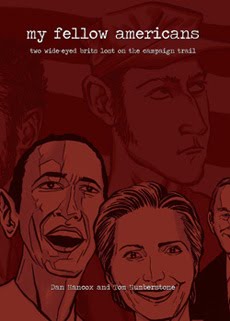
For example, Dan Hancox and I managed to publish the very first book about the 2008 American Presidential election (
My Fellow Americans) in May 2008 - before Obama had even secured the Democratic nomination. That's a very addictive advantage of the small press and one that will always keep me coming back.
As far as the worst thing: I suppose it's attempting to do it all. As much as I absolutely adore wearing so many hats (editor, artist, designer, art director, publisher, press officer, distributor, events co-ordinator... etc.), I think it stands to reason that there are some things I'm better at than others.
Attempting to do all of this on your own can mean doing a couple of extremely important aspects of the job poorly. But I can't afford to hire additional help. This is the one thing that could really benefit from being involved with a larger publishing house.
downthetubes: Tell us a little about Solipsistic Pop and what you're trying to achieve with the anthology?
Solipsistic Pop is a biannual anthology of alternative comic artists based in the UK. It was created with the intention of providing a high quality platform for those artists when, currently, there isn't a huge infrastructure in place that supports that sort of work. While North America has
Drawn & Quarterly, Fantagraphics, Top Shelf and various other great publishers - we don't really have anything here that's similar.
Things are changing of course. There's
Blank Slate and
No Brow Press. But I really wanted
Solipsistic Pop to exist as a kind of aperture for people to discover brilliant UK talent in a beautiful, boutique publication that wouldn't look amiss next to
Mome,
RAW or
McSweeneys on a bookshelf.
Solipsistic Pop is very much about taking the wonderful things people are doing in the small press here and then publishing it using the best possible printing methods available. Conducting experiments with inks, paper stock and pull-outs. Making the product a gorgeous, tactile artefact that shows the work in the best possible light and demands the attention of everyone with a passing interest in comic art. Doing something that makes the rest of the world sit up and take notice of the brilliant artists we have working in comics in the UK at the moment. And encouraging those artists to produce the best work they are capable of.
downthetubes: How's successful has it been so far? Where next for Solipsistic Pop?
Tom: The response to the first two volumes has been wonderful. We've been getting some great reviews and the related exhibitions and events have had enormously successful turnouts. Momentum is definitely building and I'm just about managing to break even on the whole thing. It's a lot of hard work and a big drain on my time and finances but it's worth it.
I'm extremely proud of
Solipsistic Pop and continue to be surprised at what it's achieved already.
A third volume is due in November and I'll also be announcing some events around that time. It's possible
Solipsistic Pop will go on hiatus after that while I take stock of what has been a success and where it's possible to improve. The main things I really need to start considering are whether I can publish more than 500 copies of each volume and how I can solve the problem of distribution. But it's early days and I'm very much learning as I go.
downthetubes: You do the 'auto-bio' thing, amongst other things. Do you ever worry about revealing too much about yourself (or even other people)?
Tom: I actually decided to take a break from auto-bio comics after completing
How To Date A Girl In 10 Days, only recently returning to it when I undertook the challenge to make a comic a day for 100 days. I simply couldn't see any other way of producing content on a daily basis without going for the illustrated journal approach.
With the
100 Days Comics I've been very careful to only put other people in there when it is light-hearted and jovial - trying my best not to put words in people's mouths and to make it clear to friends that I'm doing it. Everyone has been completely fine with it and often enjoy making occasional cameos now and again. But that has a lot to do with making sure I'm documenting things that they're comfortable with. If there's ever a moment of introspection or darkness, you'll most likely find the comic features me and me alone.
The only time this hasn't been the case was with
How To Date A Girl In 10 Days, which was about a relationship that didn't last more than a fortnight. We didn't stay friends and when I decided to make a comic about it (which was much less about the relationship itself and much more about being a directionless twenty-something and learning to get beyond my inability to date), I was careful to change names and hide identities. I didn't have permission to make that comic and so was very careful to make sure that I remained the butt of any jokes.
The comic actually gives you little about the relationship or the girl in question. If I was vague at points - to ensure I didn't share something that the other person wouldn't want shared - I made sure there was a point I was attempting to communicate. Looking back on it now I think I was generally successful, but I probably wouldn't attempt that comic now. I think it's an incredibly delicate line. And too easy to cross.
In terms of sharing too much of myself - that's not something I worry about at all. I'm happy to do that. Writing
Everything You Never Wanted To Know About Crohns Disease was a real eye-opener and let me exorcise a lot of demons about having Crohn's. Somehow, writing and drawing about embarrassing moments is quite cathartic and allows me to own them.
Additionally, for every personal moment I choose to share with my readers, there are another twenty that I've chosen not to. So I never worry about giving too much away.
downthetubes: Is the small press a stepping stone for you to get pro' work or an end in itself?
Tom: I'm not entirely sure my work would lend itself well to 'pro' work. But it's not something I'd dismiss - being paid to draw comics is obviously something of a dream. It would have to be the right project though and it certainly hasn't been the plan behind getting involved in the small press.
If anything, it would be nice to get to a point where a slightly larger company helped out with
Solipsistic Pop and took care of some of the distribution and marketing side of things but that's certainly something I couldn't envisage happening for some time - and wouldn't want to - I think I enjoy being the over-zealous one-man-band too much.
It would be fantastic if I could make my living out of comics as it would obviously allow me the time to draw more of them. But similarly, if I never make any money from comics, I'll continue to draw them.
downthetubes: What's your involvement in We Are Words + Pictures?
Tom: We Are Words + Pictures is a collective of talented artists and writers who are all, in some way or another, involved in comics. Matthew Sheret and Julia Scheele created it and it predominantly focuses on organising comic-related events, taking comics to comedy nights where there is potential crossover appeal or to music festivals like Latitude. The idea being that by taking comics outside of the conventions and traditional places you might find them, you can increase interest in the medium and the small press scene.
I've been helping out with We Are Words + Pictures as much as I can - designing flyers and brochures and helping to run Drop In + Draw workshops. It's a fantastic collective doing exciting things and wonderfully ties in with a lot of what
Solipsistic Pop is trying to achieve too. It's no coincidence that Matthew and I co-wrote the comic manifesto that opens
Solipsistic Pop 1.
We have a lot of similar feelings about the UK comics scene and I look forward to helping out with We Are Words + Pictures whenever I can.
downthetubes: Tom, thanks very much for your time and the very best of luck with all your projects
Web Links
• Tom's Official web site Ventedspleen
• Tom on myspace
• Tom on twitter
• Tom on comicspace
• Solipsistic Pop
• We Are Words + Pictures
• This interview also features on the Forbidden Planet International blog - A British Comics Cross Posting Promotion!