downthetubes is undergoing some main site refurbishment...

This blog is no longer being updated

The downthetubes news blog was assimilated into our main site back in 2013.

Hop over to www.downthetubes.net for other British comics news, comic creating guides, interviews and much more!
Showing posts with label The DFC. Show all posts

Sunday, 6 January 2013

Phoenix launches digital edition on first birthday

The Phoenx app screenshot
If you haven't sampled The Phoenix - the lively weekly childrens comic aimed at 8-12 year olds that sprang from the ashes of The DFC - then those of you who have or were given shiny iPads for Christmas are being offered the chance to do so as the title launches its digital edition - backed by an unbeatable launch subscription offer of just £9.99 for six months, for this coming week only.

Despite huge acclaim, a great creator line up and an attractive print subscription package (albeit, we're told, some initial glitches for some), The Phoenix, like The DFC, has suffered from a lack of presence on the shelves of your local newsagents or supermarket. It's currently to be found in Waitrose, but for a lot of the country that supermarket chain is still nowhere to be seen, so sampling The Phoenix before committing to a subscription has not been possible.

The launch of the digital edition changes all that, offering not only a great-looking comic app available worldwide, courtesy of downthetubes sponsors Panel Nine but a sampler issue as an appetiser - and a staggeringly cheap, one week only six month subscription offer.

It's an offer that has proven an instant success, with the app currently the top-grossing Children's Magazine in Apple's Newsstand, beating out CBeebies, Doctor Who, Pokemon and Barbie.

The comic reader not only enables a page per view option but also features an impressive 'Panel Mode' feature that presents each strip panel one at a time with a simple 'double tap' command. For those relucant comic readers, unsure even how to read a comic (sadly, a common affliction thanks to a decline in comics literacy), this helps them learn just how to digest a great strip before going on to enjoy The Phoenix at its full page best.

A fabulous mix of humour strips and adventure serials and carefully designed feature pages that put the boot firmly into many rivals offerings in terms of puzzles and interactivity, the launch issue of the digital Phoenix includes an impressive roster of talent.

Pride of place surely goes to the return of Pirates of Pangaea by Daniel Hartwell and Neill Cameron, plus Cora's Breakfast by Nick (Hugo Tate) Abadzis and plenty more, including Long Don Gone by Don Skelton and Star Cat by James Turner.

The app is the work of digital comics company Panel Nine, who have have created the digital Phoenix for Apple’s Newsstand for iPad service. It's a slick comic reader, with a good choice of font size and the aforementioned Panel Mode view (although I think I'd still like a pinch and zoom option, too, but you can't have everything).

Given that a single printed issue costs £2.99, the subscription launch offer is really good - but it ends very soon, so head over to the iTunes store now to take advantage!

Now all we need are digital back issues or print/digital collections of the best strips in the first 52 issues of this great comic!

• The six month, 24-issue subscription is going to be available for the first week only at the quite amazing price of £9.99 ($13.99) (that's something over 80% off). Go to https://itunes.apple.com/app/phoenix-weekly-story-comic/id583824799 to download!

The Phoenix official web site: www.thephoenixcomic.co.uk


Thursday, 3 November 2011

In Review: The Boss

Mix the pupils of a single school year concept in something like Harry Potter plus the control of agents from a command centre from something like NCIS:Los Angeles with the child investigators of, say, Enid Blyton's Five Find-Outers and Dog and you have the latest title from the DFC Library, The Boss by writer John Aggs and artist Patrice Aggs.

The class of year five are on a school trip during they overhear two men plotting to steal something from the castle that they are visiting. One of the kids, known only as The Boss, quickly forms the class into teams covering the main areas of the castle as well as reconnaissance squads to find and then track the criminals.

Castle maps, video cameras with zoom lenses and mobile phones keep the class in touch with the criminals while reporting back to the Boss who tries to keep his fellow students away from the teachers while gathering enough evidence against the men to give to the police. But can a bunch of kids really save the castle's priceless illustrated manuscript from being stolen?

It is to the credit of writer John Aggs that I read The Boss straight through without even considering that it had originally been subdivided into weekly segments in The DFC comic, where this particular Boss story was called The Castle Heist. Scanning back through it again with that in mind I could see where it was split up, a few moved word balloons helping to obscure the splits, but that does not diminish the fact that this is a fast paced and involving story as the children attempt to outwit the criminals while at the same time protecting their own actions from any potential interference by their teachers. To say that this has the feel of a modern take on an Enid Blyton style adventure story may be taken by some people these days as a mark of disrespect to John Aggs, but I say it having read and enjoyed dozens of Blyton's Famous, Secret and Mystery adventure books in my youth.

Patrice Aggs' art impresses in differentiating between a posse of school children all wearing the same coloured uniforms as well as creating a convincing castle where the majority of the action is set and that the reader gets to know their way around over the course of the story. Her choice of angles in her panels keep the story interesting in what could have been a repetitive locale while her reveal of how the class capture the person they consider to be the criminal is startlingly effective.

Why do the children consider one of their number to be 'The Boss'? Who is he and, for that matter, what is his name? How does he know what to do and how are the class so good at all this 'secret agent' stuff? We aren't told and, in fact, it doesn't really matter as the story proceeds at such a fast pace that the Boss himself is onto coping with the next problem without having time for the reader to think too much about the background to the situation.

The Boss is the sort of 'kids outsmarting the adults' adventure story that children love to read, and I thoroughly enjoyed reading it as well.

• There are more details of The Boss on on the David Fickling Books website.

• There are more details of John Agg's work on his blog.

• There are more details of Patrice Agg's work on her website.

Thursday, 20 October 2011

In Review: Super Animal Adventure Squad

The most junior of the third batch of DFC Library titles is Super Animal Adventure Squad written and illustrated by James Turner.

Agent K (a cat), Agent Irwin (a pelican), Agent Rex (an iguana), Agent Beesley (a rather posh bee) and Agent Bearbot (a robot television, seriously) make up the Super Animal Adventure Squad controlled from a far by their boss, a unicorn with an eye-patch. The book covers two of their assignments to help save the world, The Teatime Of Doom and The Case Of The Baboon Bandit.

In the first story Doctor Nefarious, "the world's maddest mad scientist," is stealing all the cakes and pastries from bakeries across the country using mind-controlled ants which of course means that everyone will have to go without a mid-afternoon treat. The Squad raid his headquarters and end up fighting against a gigantic ant.

In the second story pirates steal the world's most valuable treasure, the Jade Baboon Of Rangoon, so that their leader Green Beard can use its secret to win the Battle Of The Spatulas. The fact that he also has all the greatest chefs in the world as his prisoners so that they cannot take part might help him along as well. The Squad are tasked to retrieve the baboon from Pirate's Cove

Turner's naive style of art initially takes a little getting used to but his writing, with its interesting characters, jokes and above all its puns, will soon win you round to the Squad's side. The first tale was single pages when originally published in the weekly DFC and it sets the scene, but it is the second story, which was two pages per week, that allows the plot to thicken as the characters get themselves into a stew. A set of agent profiles at the end of the book, along with a tongue-in-cheek page on how to draw Agent Beesley, round off a rather nice little package for kids.

There is an animated series on heavy rotation on the Disney TV channels at the moment called Phineas and Ferb in which the humans are all drawn as grotesques and there is a secret agent in the form of a platypus. Kids love it and this reminds me of it.

So this Christmas if you have to buy presents for kids who enjoy Phineas and Ferb then you could do a lot worse than giving them a copy of Super Animal Adventure Squad.

• There are more details of the Super Animal Adventure Squad on their Facebook page and on the David Fickling Books website.

• There are more details of James Turner's work on his blog.

Tuesday, 18 October 2011

In Review: Baggage

The DFC Library returns with the first of its third tranche of titles, and the first one that wasn't in the weekly DFC - Baggage by writer Robin Etherington and artist Lorenzo Etherington.

Randall is the lackadaisical, and somewhat disaster-prone, lost property officer for the tram service of Triptych City. After his latest disaster with a rhino, his boss, the perennially grumpy Bronco Lutz, offers him a last chance to keep his job by finding the owner of the oldest piece of lost property in the company's enormous warehouse.

Just about surviving the collapse of the enormous pile of lost luggage, Randall takes the small, old and apparently very well travelled suitcase on a quest around the city in his desperate attempts to find its owner. Using the clues on the suitcase in the form of travel stickers, Randal search becomes more and more frantic as it goes along.

Along the way he picks up his good hearted friend Taw, the sensible Mica and the nerdy collector Kong as his quest staggers from one calamity to another and the companions end up being chased by an ever growing mob of disgruntled people. Will they find the owner of the suitcase before the day ends or will the mob get to them first?

One word best fits the Etherington Brothers work, be it the writing or the art, and that is 'manic'. Robin's writing is so off the wall that the plot is never going to be predictable or even, for that matter, straightforward. But that is to the book's benefit as what could have been a simple quest storyline swerves constantly between increasingly bizarre situations. Lorenzo's artwork is beautiful, dynamic when it needs to be and intensely detailed in the quieter sections as the mainly feline characters work their way around the city.

The Etherington's previous DFC Library title, Monkey Nuts, worked well in the weekly comic but suffered somewhat as a book due to the constant action required of a short weekly humour strip which made it something of an exhausting read. Baggage gets over this problem as the action is not as intensely constant, although Monkey Nuts fans will enjoy spotting the in-jokes in Baggage that hark back to the previous title.

Baggage is a visual delight that works just as well for adults as it does for children. With Christmas coming up this is one book that could just as easily be on your own 'wants' list as well as being on the list of presents to be given out to others.


• There are more details of Baggage on the David Fickling Books website and the Etherington Brothers blog.

Thursday, 26 May 2011

Phoenix Comic post Submission Guidelines

The Phoenix Comic - the new weekly comic springing from the ashes of The DFC - has just updated its website and also published its submission guidelines, which we're running here in full.

Launching in January 2012, the team say the 32-page comic will offer both humour and adventure strips, along with features and puzzles.

The Phoenix Comic is looking for strips with heart – stories that are open and engaging, whether they are told across three panels, three pages, or episodically over several months.

"We’re always open for new submissions of self-contained (ie conclusive within one issue) and episodic strips.
 We consider pitches from makers working alone, or from writer/illustrator teams and are interested in strips in the following forms:
  • Single panel to single page (fiction or non-fiction), self-contained
  • 
Visually dynamic non-fiction spreads, self-contained

  • Longer form episodic fiction strips (up to 3pp per week)

"Right now we’re particularly interested in receiving pitches for stand-alone (conclusive within one issue) stories of 4pp in length.

"We’re also keen to hear from puzzle-makers with experience in producing challenging and fun puzzle content for 8-11 year olds, and artists with experience of providing occasional illustrations for text content.

When it come to what they're not looking for, the Phoennix will not be publishing material for  very young children, or teenagers, or adults, or strips bulging with counter-culture angst. "We won’t be a good home for you. Sorry! And at present we are not accepting material from authors with a script but no illustrator on board."

To submit material, include the following in your submission:
  • a brief outline of the concept and, if not stand-alone, short detail on the proposed story arc and intended number of episodes.
  • a script for the first episode
  • style sheets showing key characters, a sample page layout and indication of finished colour work.

Tech info: detail on paper finish TBC but please assume a sheet-size of 211×297 (A4).
You can email your submission to: submissionsATthephoenixcomic.co.uk or send by post to: The Phoenix Comic, 29 Beaumont Street, Oxford, OX33 1AL (please enclose an SAE if you would like your material returned).

The Phoenix crew point out "we are a very small editorial team and look closely at every single submission. Sometimes this can take a little time.

"We will get to your material as fast as we can, but you may have to wait up to six weeks for a response (sorry).

"If we think your submission has potential we’ll contact you to arrange a meeting to discuss the material in more depth.

"If your submission isn’t right for us we will let you know the core reasons for rejection. And, in that event, please don’t give up hope – there are many other potential homes for great content out in the world and in many instances we will be saying no simply because of space limitations. We have to make tough choices, and of course there is a degree of subjectivity involved too. Unfortunately time constraints prevent us from engaging in extended correspondence on rejected submissions."

• Help spread the word about The Phoenix Comic and point parents, teachers, librarians and everyone else to www.thephoenixcomic.co.uk

Saturday, 5 March 2011

Phoenix: a new British comic rises from the ashes of The DFC

A new British comic is in the offing, edited by former The DFC editor Ben Sharpe.

Contrary to earlier reports on Lew Stringer's blog, bleedingcool.com and elsewhere, Ben says The Phoenix is not a revival of The DFC, although its editorial team will include Will Fickling, who was heavily involved in that weekly subscription title.

"The Phoenix isn't affiliated to David Fickling Books or any other publisher," says Ben, who clearly enjoyed his time on The DFC, which gave him the chance, we gather, to look at wonderful artwork all day, and have vital conversations like 'how many nipples is it appropriate to show on strips about 30s-era crime-fighting dogs', 'do sheep really have the lung capacity to master the tuba' and 'does super-strength make a schoolgirl super-fast or actually a little bit ponderous'.

There's scant details of what format the title will take but it does seem that several DFC contributors will be involved, including Gary Northfield and Emma Vieceli.

They will be looking for submissions: Ben says he will post info on what they're particularly looking for as soon as the comic's main website goes live.

More news as we get it!

UPDATE 5 MARCH 2011: The Phoenix comic now has a website.

On a related note, three more books based strips from The DFC are due to be published in late 2011 from the David Fickling Library: Baggage from the Etherington Brothers; The Boss by John and Patrice Aggs; and Jame's Turner's marvellous Super Animal Adventure Squad.

• If you'd like to be on the early mailing list for The Phoneix, DM Ben Sharpe on Twitter

• Track news of The Phoenix comic on Twitter: http://twitter.com/search?q=thephoenixcomic

Friday, 25 February 2011

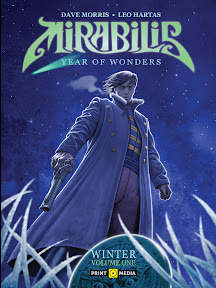
Print Media to publish Dave Morris and Leo Hartas Mirabilis project

Print Media Productions has announced it will be publishing hardcover editions of Mirabilis: Year of Wonders -- a huge graphic novel project by Dave Morris and Leo Hartas, also available on iPad and soon to debut on digital platforms Graphic.ly and Comics+.

Mirabilis is a fantasy adventure story for young adults which opens New Year’s Day 1901, when a green comet appears in the sky. As it gets bigger, the line between reality and fantasy blurs. Soon there are mermaids in the Thames, elves in Parliament and a dragon roosting on Big Ben. But then the comet rounds the sun and starts to fade. Will the world be able to go back to a life without magic?

The full-colour graphic novel was originally serialized in The DFC, the weekly print comic published by Random House UK, who financed the production and has been released as a digital edition for iPad.

Published by Random House, The DFC treated several thousand devoted subscribers to the very best in British graphic fiction, with stories by top-name talent like Phillip Pullman and Harry Potter artist Adam Brockbank.

The biggest single project among all The DFC's ongoing stories was unquestionably Mirabilis, a hugely ambitious comics saga planned to span almost 200 issues. Billed as "a modern Tintin", Mirabilis's planned 800 pages equals more than a dozen volumes of Herge's classic comic series.

When The DFC closed, Mirabilis creators Dave Morris and Leo Hartas had barely begun to tell their epic yarn. The next two installments appeared on the Mirabilis website (www.mirabilis-yearofwonders.com) and drew almost 8000 hits. That's when Hartas and Morris realized they could be onto something.

"We couldn't bear to end our story there," explains Morris, a bestselling UK author and a mentor with the American Film Institute. "You have a duty both to your readers and to the characters you've created not to leave them in the middle of a cliff-hanger."

"The question was how to finance the project," says Hartas, the award-winning illustrator who draws the Mirabilis comic. "It's a recession and nobody was investing in anything. Then we decided, to hell with it – rather than looking around for new work, we'd just get our heads down and complete the story."

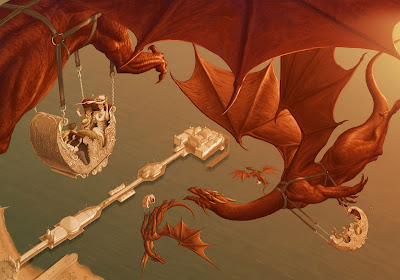
Dragon Rides - art for Mirabilis by Leo Hartas

The new Mirabilis

The first season of Mirabilis is now ready. Mirabilis: Winter is a whopping 200-page book whose eight chapters comprise the first act of Mirabilis's year of wonders. Morris and Hartas had several discussions with David Fickling, The DFC's ebullient editor, about releasing it through his book imprint. But the tortuously slow progress of print publishing meant that the first volume wouldn't appear until late 2012 – and Fickling and his Random House paymasters couldn't commit to future books until they saw the sales figures.

"In the end, much as we would have loved to stay with the Fickling label, we decided to keep doing it our way," says Hartas. "We just wanted to get the work out there in front of readers as soon as possible."

Two events provided the key to achieving that ambitious goal. First with the release of the iPad, which allowed Morris and Hartas to launch a digital version of the comic in time for Christmas 2010, and then in a deal with Print Media Productions, who have signed up Mirabilis: Winter for release as two prestige-format hardback volumes that will be in UK bookshops in 2011.

Morris and Hartas had already had offers from digital publishers to release Mirabilis on iPhone, but were reluctant because the small screen didn't do justice to the fabulous full-colour artwork. "A graphic novel page is not merely a storyboard sequence of panels," says Morris. "On a phone screen you lose too much of the full reading experience of a printed book. The iPad, though, that's another matter."

Teaming up with Brighton-based TDB Software, Morris and Hartas drew on both their creative and entrepreneurial experience to set up Mirabilis on iPad through their own Mirus Entertainment label. The Mirabilis app is free and comes with the first 25-page chapter already loaded. Subsequent chapters are $1.99 and have been crafted to evoke the experience of collecting a set of comic books, right down to the covers and letters page.

"A comic is more than just a novel with pictures," says Hartas. "It's about community, it's about being drawn into a completely immersive fantasy world."

As inveterate comic and book collectors, Morris and Hartas were not content for their story to only appear digitally. “That’s why the offer from Print Media Productions came at such an ideal time,” says Hartas. “Print Media have their own print works in Europe, meaning that we can work closely with our editor, John Freeman and publisher Ivo Milicevic, to get the production quality tuned to perfection without the long delays that other publishers have to suffer with books being printed out in the Far East.”

The first volume was printed last week in Bosnia, and Dave and Leo were involved in pre-production every step of the way.

The Print Media edition of Mirabilis: Winter is being published as two top-quality hardback books, each of 112 pages, at the large-format album size traditional for European graphic novels that can be seen in a series like Charley’s War and the company's first graphic album release, The Iron Moon.

Mirabilis: Year of Wonders Volume 1 is now being solicited by Diamond (Order Code FEB111949), joining Keith Page and Stephen Walsh's Iron Moon title as the first graphic album projects from the new British company.

• More information on the Print Media web page: www.stripmagazine.co.uk

Mirabilis: Winter Book One can be ordered via Diamond Previews, Order Code FEB111949.


Mirabilis on iTunes . Versions for Graphic.ly and Comics+ will be announced soon

• Learn more at www.mirabilis-yearofwonders.com

Wednesday, 15 December 2010

Mirabilis graphic novel released as iPad app

Mirabilis: Year of Wonders, a graphic novel by Dave Morris and Leo Hartas first seen in The DFC comic launched in the App Store for iPad this week.

Mirabilis is a fantasy adventure story for young adults which opens New Year’s Day 1901, when a green comet appears in the sky. As it gets bigger, the line between reality and fantasy blurs. Soon there are mermaids in the Thames, elves in Parliament and a dragon roosting on Big Ben. But then the comet rounds the sun and starts to fade. Will the world be able to go back to a life without magic?

The full-colour graphic novel was originally serialized in The DFC, the weekly print comic published by Random House UK, who financed the production. Mirabilis is the first of the DFC strips (which include Mezolith, Mo-Bot High and Monkey Nuts) to appear on iPad.

The iPad app comprises the first 200-page season in what Morris and Hartas plan as a four-book epic.

“iPad is a game changer for graphic novels,” says Mirabilis writer Dave Morris, a former number one UK best-selling author. “Go into most bookshops in Britain, you’ll be lucky to find the graphic novel section. Even in the US, they’re mostly just available in hobby stores. Yet suddenly the graphic novel market is worldwide, portable, affordable, open to everybody.”

“As soon as we saw the iPad we knew we had to release Mirabilis on this platform first," adds Leo Hartas, the story’s co-creator and illustrator. "The quality is better than print. The colours have to be seen to be believed."

Despite their obvious (and deserved) enthusiasm for the iPad, Dave and Leo aren't leaving print behind. Hardcover volumes of the Winter story will be published by Print Media Productions next year, and serialized print editions are in negotiation for India and the United States.

Mirabilis iTunes on iTunes

• Learn more at www.mirabilis-yearofwonders.com

Friday, 24 September 2010

Colliding Words and Pictures: An Interview with Sarah McIntyre


Sarah McIntyre (left) with the 'Fleece Station' creative crew  - Lauren O'Farrell and Gary Northfield - at MCM London 2010. Photo: Jeremy Briggs
Cartoonist and illustrator Sarah McIntyre first came to Matthew Badham's attention via her Vern and Lettuce strips in weekly subscription-only comic The DFC. Since then, like many others, he's been following her work both online and in print. She's a fantastic artist whose mini-comics never fail to make us smile.

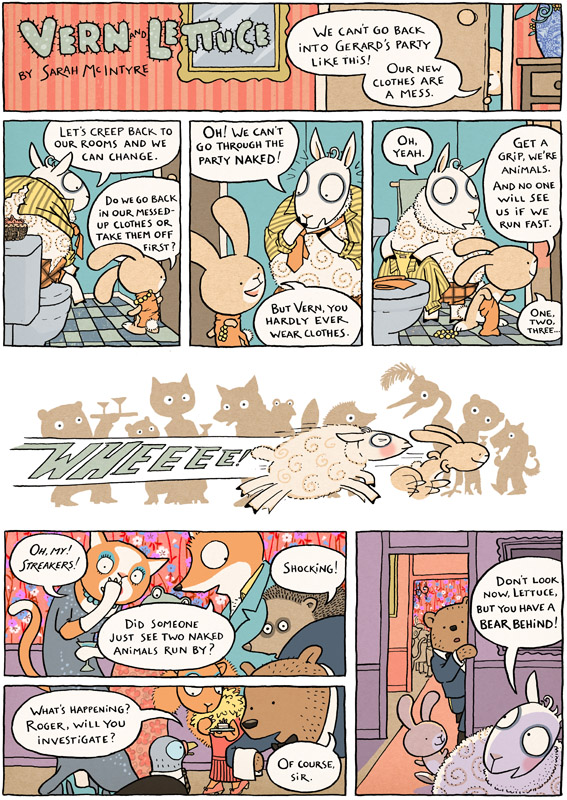
Vern and Lettuc e by Sarah McIntyre
In this interview, Sarah talks about her art education, the links between comics and picture books, and why she sees a healthy future for the British comics scene...

(This interview is also being cross-posted on the Forbidden International blog)

downthetubes: Are you a formally trained or self-taught artist?

Sarah McIntyre: A bit of both, really. A very kind art teacher give me after-school oil painting classes, starting when I was five. I spent the next six years mostly painting kittens, puppies and rather tedious landscapes, but it made me love mucking in with paint. My high school art teacher was also great in that she didn't make me follow the class assignments, just let me set my own projects and get on with them, even if I had to stay through lunch break or after school.


Sarah and a 'slightly dotty' Hungarian
I also took a few oil painting classes from a wonderful and slightly dotty Hungarian woman who collected filing cabinets full of dead crows that had been run over on the road in front of her shop, so we could draw them.

I didn't think I could earn any money doing fine art, so I studied Russian at university. But in the United States, we have this great option of completing a 'minor degree', which is half a regular degree, so I did my minor in History of Art. And the professors there let me fudge the requirements a bit so a lot of that time was spent drawing life models in the art studio instead of memorising slides.

Before my last year of university, I spent two years in Moscow, running around its galleries and museums, teaching myself a lot about Russian painting and its arts and crafts movement at the end of the 18th, beginning of the 19th century. Until I realized I couldn't live on the pay of three dollars an hour, I worked in the Moscow branch of Shakespeare & Co bookshop, and we hosted these marvellous arts evenings where I got to meet loads of fascinating painters, sculptors, writers and poets, and occasionally I'd get to see their studios.

I spent several years working as an illustrator, just taking a few evening classes here and there. My favourite short course leader was Elizabeth Harbour, who set loads of brilliant little book projects, similar to the kinds of things you see at small press fairs now. She's the one who got me set on the path to making full books, not just drawings.


The Bottle - art college
work by Sarah
About five years after moving to London, I enrolled at Camberwell College of the Arts to do my Master's degree. I was lucky, it was the first year Janet Woolley began leading the course, and it was still small, only 14 students. (I think it's over 50 now). Jan combined being a total powerhouse with being quite mumsy; she really cared about the people on her course and looked after us at the same time as pushing us hard and being utterly frank with us.

What I didn't learn on that course, I was able to pick up from the Association of Illustrators Business Start-up classes and seminars led by the Society of Children's Book Writers & Illustrators. And Ellen Lindner, who was on my course [and who now edits the anthology, Whores of Mensa], started me off learning about comics, pointing me to the kind of comics I actually liked, not the kind I'd seen when I walked into mainstream comic book shops.

I think it wouldn't have been too difficult to slide through the course without doing much; I tried to come up with at least one piece of artwork every day and I think that decision made all the difference. I only felt I'd made my first real breakthrough about a week before the final show. Jan and the Graphic Design leader actually let me set up a second, separate show in the hallway because my work had changed so dramatically between the stuff I'd carefully printed up for the exhibition and the artwork and comics I'd been doing in the meantime.

downthetubes: So when did you actually start making comics?

Sarah: When I was about eight years old, I used to make a magazine called Family Favorite and leave it on my neighbours' doorstep, ring the bell and run away. I think the first comics I ever made were for that magazine, and they were copied, possibly even traced, from Archie comics. But all the comics I ever read in the Seattle Times or Archie seemed to have funny punch lines, and I didn't think I would ever be able to do that. And I read a few of my mother's stashed-away story comics (Jack London's White Fang, a couple fairy tales) but they were so old and brittle that I didn't think people still made them. I didn't even connect them as a storytelling medium with the funnies in the newspaper. In fact, the linework and colours looked so polished to me that I never even thought about real, live people making them at all. Maybe I thought they grew on trees or something.

Comic created at college
by Sarah
I think my first comic was a little book I made for my dad for his birthday, telling his life story from my point of view. It was more of an illustrated book that a comic, but if would have fit in with minis you see at small press fairs.

My first comic I made at art college was a double-page spread about some yobs throwing a beer can into the Thames and then the river bursting its banks to take revenge on everyone. Ellen gave me some good tips on it and it made me start thinking more seriously about making comics.

I read a book called On Sight and Insight by John Hull about the experience of blindness and thought I'd write a graphic novel with a character in a soundscape environment, simulating blindness, but in a visual way, using typographical artwork. That subject was way too big for me at the time and I had to shelve it. I also made a couple travel minis and took part in an online comics jam with some people on LiveJournal.

Then the opportunity came up and I cheekily promised David Fickling I could do a page a week of comics for The DFC. I practically had my fingers crossed behind my back when he asked me if I could do it; I had absolutely no idea if I could, and I sweated bullets. But I approached Vern and Lettuce like a children's book, just drawn within panels instead of pages, and the editor didn't ask me to stop, so I figured it must be okay. I was overwhelmed when people started telling me they liked it.

Vern and Lettuce by Sarah McIntyre
downthetubes: What did producing Vern and Lettuce, a weekly comic, teach you in terms of making comics and also the business, deadline, discipline side of being a comic artist?

Sarah: I was already used to deadlines and discipline from making picture books, although I still had a lot to learn about the business side of things. When I started with David, I was approached by one of the best agents in the business and she's made my work phenomenally less stressful.

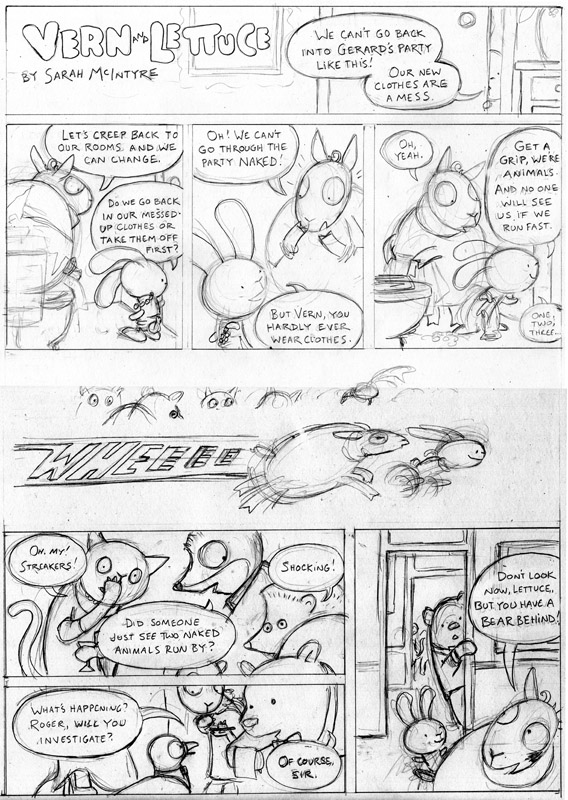
Vern and Lettuce Pencils


Pencils stage for a page of Vern and Lettuce
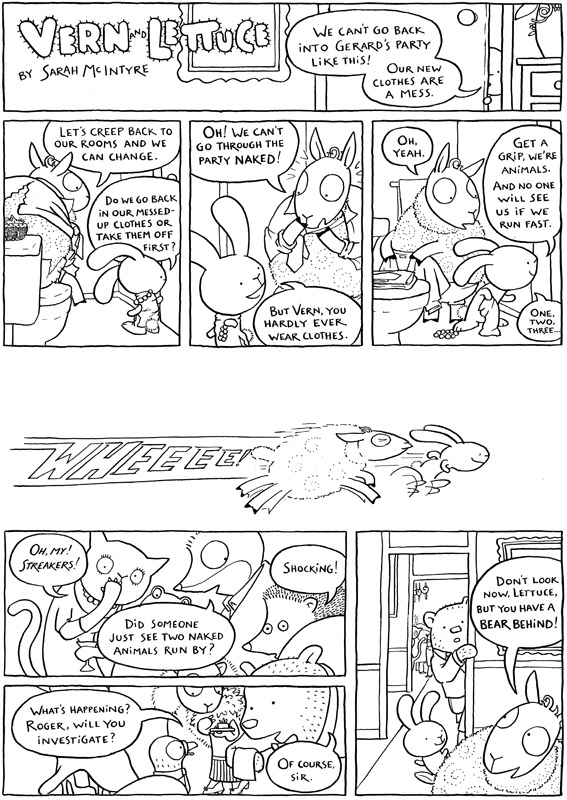
Vern and Lettuce Inks


Inks for the same page...
Vern and Lettuce Pencils - Final Colour


Initial lettering...

Vern and Lettuce Pencils - Initial Colour

-- and the final page
In terms of making comics, I'd never submitted more than a few single illustrations in digital form, and I still had a lot to learn about Photoshop. I still only really know what I need to know, but I try to keep things simple by sticking as closely as possible to the methods of traditional printmaking.

For Vern and Lettuce, I tried to think of the layers in Photoshop as the layers in a screen print, one layer per colour. I hate the overly slick, airbrushed effects and gradients so many people rely on in Photoshop; it often it makes beautiful linework look like cheap pizza flyers, or makes everything look muddy. But I love the imperfect, slightly textured look of hand painted signs, and I saw some gorgeous revolutionary posters in Moscow in places like the Mayakovsky Museum. They owe a lot of their visual power to the fact that the painters didn't have many colours of paint, they just made do with two or three tins. With Photoshop, I can access millions of colours, but if I just stick to a few, my work looks so much better.

There's a lot of experimentation in Vern and Lettuce with this; I was very strict with myself in the first few pages, then I started to introduce more and more colours until about episode twelve, when I got frustrated and reined in my colour palette again.

Writing was also difficult, the relentless pace of the weekly deadline. In the beginning I had a few weeks to play with, but then I took a holiday and after that, I was finishing bang on the day the strip was due for print. There's this tricky thing, just like in picture books, where there's supposed to be a sort of 'flip' at the end of the story. It can be a joke, but it doesn't even have to be funny, just something to give the strip closure and make the reader look at things a bit differently.

A lot of the other DFC people I talked to started their stories with this end point in mind, but I never did. My way of working was just to put Vern and Lettuce into a situation and see where they went. They're so real to me that I can hear exactly what they'd say to each other. And sometimes they defied tight little endings, they still weren't very domesticated animals.

A few times they got me into a real panic and I'd ring up my DFC colleague Woodrow Phoenix, who lives nearby. He would patiently look at where my strip had gone and then walk me through to the end of it. It's been the same working in a studio with Gary Northfield; it's shown me that endings aren't magic, that much of the job just requires focusing and taking things to their logical conclusion, and then one step beyond. I think it's the ‘one step beyond’ that looks like magic to the rest of us. (I think DFC artists James Turner and Jamie Smart live in the land of one step beyond.)

Doing comics jams with David O'Connell also helped me get my writing out of terrible ruts. In a comics jam, I can't get pig headed about where a strip is going; when I hand the next page over to Dave, he always takes it in a direction I would never have dreamed up. When I get his page and start on the next one, it's almost like a completely fresh story.

That really helped show me that there's never one solution to telling a tale, the permutations are infinite, and when I'm stuck, instead of blundering on with something dull, I can step back and send the story flying in a completely different direction. And writing with friends makes things more fun.

Vern and Lettuce were great to me that way, in introducing me to so many amazing comics friends who know how to combine hard work with being a bit silly.

downthetubes: Can you give me a couple of examples of 'flips' from your own work?

Sarah: Well, things such as the raisins in Vern's cake ingredients, which turn out to be something much less palatable. Or the little stowaway moles that parade out of the airship, just as Vern thinks he's going to get some peace in his park keeper job.


Comics jam work with David O'Connell
downthetubes: You make comics and picture books. What's the difference between the two? Is there a difference? Is any distinction arbitrary, they are, after all, both collisions of text and art? What do picture books do well that comics don't and vice versa?

Sarah: This is a huge subject, I can do long workshops on the answer to this, and it needs me to show lots of visual examples. But I was amazed with The DFC, at how smoothly I could transition from picture books to comics. In the old days, a lot of picture books had very simple formats: a picture, possibly in a box, with text underneath. But there’s more of a move to vary formats in picture books now, and make the text intertwine and work with the pictures. I’ve always liked doing this, and never wanted to leave it solely to the book’s designer.

Often in picture books, you’ll see several small images on a page, which picture book editors would call ‘vignettes’, and comics people would call ‘panels’. Many picture book people (Russell Ayto, Mo Willems, Posy Simmonds, Raymond Briggs, Satoshi Kitamura, loads of others) have been using comics formats for years, even if they wouldn’t have called it that, or wanted you to call it that. I remember the surprise of learning that Maurice Sendak’s 1970 book, In the Night Kitchen, was a direct tribute to Winsor McCay’s Little Nemo in Slumberland. I always knew it as a picture book, but of course, it’s a comic, too, and a love letter to comics.

I don’t think there has to be any boundaries between picture books and comics. I think they can flow into each other entirely seamlessly, and keep people developing their visual literacy well after they’ve moved on from reading only children’s books. And it lends added sophistication to children’s books, when kids can read a book that’s slightly above their level without it being a huge break from picture books to text-only novels.

I think this merging needs two things to happen: Editors need to overcome their prejudices against books looking too much like comics, or ‘cartoony’ (a damning adjective in an editor’s office). And I think this is happening, as they realise there’s a market, and librarians go nuts trying to get their hands on these books that ‘reluctant readers’ will pick up. (You can see this happening with picture book publishers such as David Fickling with his DFC Library, Walker Books, a bit with Templar; and even more so in the USA with Toon Books, Scholastic Inc and others.) Some editors are starting to warm up to speech bubbles, as a clear and vibrant way of showing who’s talking on a page.

Children’s magazines such as Okido and Anorak are just getting on with it and making lovely non-traditional, kid-friendly comics. And some publishers are tentatively starting to experiment with publishing adult picture books, such as those by Audrey Niffenegger (although she had to prove herself first with a text-only novel).

It’s essential that comic fans do their best to let people know about the new books they love, so we’ll get a chance to see more of them. Write reviews, blog about them, make as much noise as you can.

The second thing is that comic creators need to go visit the children’s book sections in shops, see what’s happening right now in publishing, and accept that some stories can be told without having to rely on sexual clichés, excessive violence or bad language, and that it doesn’t make them a wimp for writing these kinds of stories.

(I keep hearing comics people saying ‘I’ve got this amazing character, who fights this character, it’ll be awesome!’ And that’s their whole story.)


I think sometimes people switch into a different mode when they’re writing for children, they get very patronising, clichéd, or even boring (because their adult comics rely on sex or cheap shock tactics and they suddenly can’t use them). Or they over-egg the pages with so many high-impact graphics that there’s no resting time for the eyes and it’s hard to read. There’s nothing wrong with a comic that has a single panel on a page.

I think simpler formats with less panels may be a way forward for making comics for children. Astrid Desbordes Reflections of a Solitary Hamster does this well: sometimes a single panel, sometimes two, three or four panels, but the large pages have plenty of breathing space.

Kids like clear stories with solid plot lines and well-developed characters they can relate to. I believe, if you can write an excellent story for children, adults will like it just as much as the children. I think it was Philip Pullman who said something about the difference between kids books and adult books: that adults remember what it was like to be kids and can relate to the experience, but kids have no idea what it’s like to be adult yet, even though they wish they could. So you need to keep that in mind if you’re writing about adult characters or including adult conversations in a children’s book, don’t talk over their heads. You can have more than one story going on a page at the same time, but the simplest story always needs to be the best one, don’t neglect it for subtext.

In terms of format, picture books tend to be shorter, full-colour, and better paid for the amount of work put into them. You might earn as much for a 32-page picture book as a 200-page graphic novel. Which means the picture book editors will scrutinise each page in much more depth. As comics get more popular (and I don’t doubt that they will), hopefully publishers will raise their payments for comics, but it may take the best comic creators getting good agents, or really learning hard negotiation tactics before this happens.

downthetubes: What next for Sarah McIntyre?

Sarah: A week after Vern and Lettuce comes out, I’m launching another picture book with the writer Anne Cottringer, called When Titus Took the Train. (You might recognise one of Anne’s other books, Eliot Jones, Midnight Superhero). The editor and designer said they really wanted me to illustrate it because of my ‘comic sensibilities’.


I originally thought they wanted it in comics format, but it’s more of a straightforward picture book. But there are bits of comics creeping in from all sides. Woodrow lent me some of his Western comics, such as Bat Lash, Buffalo Bill and Johnny Thunder so I could get into the wild frontier swing of things.

The story’s about a kid named Titus who goes by himself on a big train journey, which gets more and more fantastical, so it’s not entirely clear what’s really happening and what he’s imagining. Bandits, white water canoeing, a T-Rex… actually, Gary helped me with the dinosaur because mine wasn’t looking nuts enough. I thrust a post-it note across the studio at him and begged, ‘Gary, please please will you draw me a T-Rex?’ He scribbled something in two seconds that was just perfect. So you might notice that my dinosaur looks an awful lot like Gary’s Derek the Sheep. (I call him Derek the Dinosaur. It’s one of my favourite spreads.)

downthetubes: Who would you like to big up, comics-wise, on both the small press and the pro' scene?

Sarah: I’m constantly amazed by the pictures Warwick Johnson Cadwell keeps making. Such amazing line work and colouring, and he looks every part the boat captain that he is. (I’m a bit smitten with him, can’t you tell?) He contributed to the first Birdsong anthology, and I’m also keenly watching the work of another contributor (and one of its editors), Will Kirkby. He also has gorgeous line work, and I’m hoping he takes his more epic, Japanese influenced tales and turns them back to his hometown in Sheffield to tell more personal stories. (But that’s just me, we’ll have to see where he goes.)

Darryl Cunningham is on a roll after launching his hard-hitting novel Psychiatric Tales. Viviane Schwarz is working on a marvellous sheep comic with Walker Books and she’s posting its progress on her blog.

My three studio mates at the Fleece Station, Gary Northfield, Ellen Lindner and Lauren O’Farrell all have amazing projects up their sleeves at the moment and we all joined together because get so excited about each other’s stuff. We all work in slightly different areas, and I think some great thing are going to happen in the places where our creations cross over. And the DFC Library crew are making magic, I’m so excited by the books they’re putting out.

I think Nikki Gamble, who heads the Write Away website and huge picture book review database, is very hot on comics for children and teenagers, and sharing them across the country with teachers and librarians. So I’m hoping we’ll get a lot more comics in front of kids with the help of people like her, Paul Gravett and others, and the industry in Britain will make even more business sense to publishers and booksellers and really take flight.


• There are more details of Vern and Lettuce on the DFC Library website (along with sample pages) and also on the David Fickling Books blog.

• Sarah McIntyre also has more details of the book on her website and her blog.

• Our review of Vern and Lettuce will be published on 30th September, just as it goes officially on sale

Thursday, 29 July 2010

Etherington Brothers announce new project and bargain book sale

Those wacky Etherington Brothers - whose work includes strips for Titan's Transformers comic, The DFC and more - are offering a limited one week only 20% off deal on collections of their own creator-owned material, which are available via Print on Demand service Lulu.com.

"You're gonna have to move fast to take advantage of this one," enthuses Robin Etherington. "We're offering you 20% off El sketchbook Lorenzo Deluxe collection and/or Malcolm Magic Big Kahuna Collection until 1st August 2010.

"That's a massive £4.99 off the sketchbook alone! Just go here, choose the books you want and enter the code "TWIST" at checkout to make your lovely big saving! You're welcome!"

The boys are clearly in a generous mood thanks to just signing a deal to produce a series of Etherington Brothers illustrated novel series - a project that has been in development for a while.

"Like every creative endeavour, it has taken time to mould this project into the perfect vehicle to satisfy our comic and storytelling sensibilities," says Robin.

"We set out to create a series that we'd have been desperate to read as young boys and our fantastic editor David Fickling has been instrumental throughout the process. It's an absolute delight to team up with David and Random House again and follow Monkey Nuts and Baggage with the first two titles from our forthcoming (ongoing) children's series.

"The books be jam-packed with action and adventure," he enthuses, "and filled with page after page of illustrative wonder courtesy of Lorenzo's scribbling paw."

The boys many fans need not worry that this new project means they have turned their back on the world of comics. "Not in the slightest!" says Robin.

"This is an exciting undertaking for our little studio but the fun of sequential storytelling is in our blood. As such these books will contain more than their fare share of speech bubbles and comic panels!"

• Check out the Etherington Brothers latest news via www.studioblinktwice.com

Thursday, 15 July 2010

The DFC Will Rise Again

(With thanks to John Anderson of Soaring Penguin): The acclaimed but sadly short-lived weekly comic The DFC will return, says publisher David Fickling - possibly as soon as next year.

Speaking at a presentation for the Society of Children's Book Writers & Illustrators earlier this month to promote the new DFC collection of Sarah MacIntyre's Vern & Lettuce (due for release in September), David Fickling spoke enthusiastically about his comic project, which was published by Random House and accepted some of the criticisms made about the title, including concerns the content had been too wide ranging for the target audience.

When he started The DFC, David explained he had a three-year plan that had had the approval of Random House, that included newstand distribution and a more international circulation. He started with a subscription base because it was the easiest to control with minimal resources. He accepts that this was probably a mistake, one that he won't make again.

David indicated that it was only when the economic climate turned bad that Random House's parent company pulled the plug on The DFC. However, he has plans to revive the title in the latter part of 2011, but only if he has sufficient funds that he can do it properly. This would include positive sales of the DFC-related books and includes the sale of the last of the DFC stock still available.

Several collections of the comics origianlly published in The DFC are now available, including Good Dog, Bad Dog and Mezolith, with more titles - Vern & Lettuce and Monkey Nuts among them - out later this year.

Responding to a general concern from some comic creators that the content of The DFC was too broad, in that some of it was for children and some of it was more suited to young teenagers, David said that choice was a conscious decision, as he wanted a title that appealed to a broader range of readers.

However, he accepts that this might have been detrimental, and in the revision, he said he would be narrowing the scope of the stories.

In a broader sense, David also noted that he needed The DFC to succeed so that it wouldn't be used as a precedent for any other company being approached to start a weekly title. On a more personal level, he wants The DFC to succeed because he has such pride and enthusiasm for it.

The event gave David another chance to praise not only his creators, but also longtime British comics fan Paul Gravett who had initially introduced him to a number of creators. It also provided a great opportunity to promote the new books Morris the Mankiest Monster and Vern and Lettuce.

• For more on comics and books by John, who's also publisher of the magazine From the Tomb, visit www.soaringpenguin.co.uk

Thursday, 18 March 2010

The DFC LIbrary goes on air!

good_dog_bad_dog.jpgBetween May 2008 and March 2009, children’s book publisher David Fickling launched a bold experiment in creating a new kids comic – The DFC – for the British market, which on a weekly basis featured new stories in a variety of genres from some of Britain’s best up and coming comics creators, not to mention a lead strip written by Philip Pullman.

Unfortunately the comic folded after 43 issues, but now a year on, the first three volumes of The DFC Library have been released, reprinting collections of material in European Graphic Album format.

On tonight's Strip! radio show on ResonanceFM, Alex Fitch talks to Kate Brown, the award winning creator of Spider Moon, Dave Shelton, the creator of Good Dog, Bad Dog and Ben Haggarty, the writer of MeZolith, who, with artist Adam Brockbank has created a book that one critic has already called “the most important British graphic novel of the last twenty years”.

The story is set 10,000 years ago, when the Kansa tribe live on the western shores of the North Sea Basin, where danger is never far away. Each season brings new adventure, each hunt has its risks, and each grim encounter with the neighbouring tribe is fraught with threats. Poika, a boy on the verge of manhood, must play his part and trust the strength and wisdom of his elders. This is a tale of beasts and beauty, man, magic and... horror.

Kirk Bergman and Duncan McBoo are the stars of Dave Shelton's Good Dog, Bad Dog: two pedigree police, the finest canine cops in all Muttropolis. And they're never short of work. The city is heaving with cunning crooks and malevolent mongrels who would sell their own mother for a bone. Join our dog detectives as they chase leads, sniff out crime, collar the bad guys and generally get their teeth into adventures full of action, suspense and ...milkshakes. Criminals beware: McBoo and Bergman are on your tail!

Spider Moon starts with tales of a prophecy, of homelands being crushed by a falling sky, at a time Bekka and her people are facing the end of days. They must do all in their power to save themselves from the fate they believe is theirs. But destiny is like a tightly coiled snake. Which Bekka must unfurl without getting bitten...

• Strip!: The DFC Library airs at 5.00pm today (Thursday 18the March) on Resonance 104.4 FM (London) / streamed at www.resonancefm.com / podcast online tonight at www.panelborders.wordpress.com

Monday, 1 February 2010

Hi-Ex Update: Shelton, McIntyre, Heggie confirmed guests

Hi-Ex 2010 Poster.The Scottish HiEx comic convention has just announced several guests for its next event in March 2010.

Taking place at Eden Court Inverness (27th and 28th of March), the convention - very much a family event - will feature a number of exciting new events over the course of the weekend, including plenty that will appeal to young children and families.

A Kids Corner, where members of the DFC Library team will be on hand, is just one such item, an event marking the impending launch of three collections from the much-missd subscription-only weekly, The DFC. Each book showcases a single strip from The DFC, starting in March with Good Dog, Bad Dog by Dave Shelton, who is a Hi-Ex guest. Dave describes it as "a knockabout comic noir adventure comedy full of slapstick humour, terrible puns and exciting action"!

(Good Dog, Bad Dog is followed by MeZolith in April from master storyteller Ben Haggarty and artist Adam Brockbank and The Spider Moon in May by Kate Brown).

Sarah McIntyre , author of Morris the Mankiest Monster, will also be on hand to help the younger (and older!) visitors who fancy trying their hand at creating their own monster.

And as if this wasn’t enough, this year sees the welcome return of Kev F Sutherland and his famous comic masterclass, with help from funding from the Highland Council. Plus, as an added bonus this year, Kev will also be putting on a performance of the hilarious Scottish Falsetto Sock Puppet Theatre.

Also part of this year's line-up are Morris Heggie, former editor of The Dandy and author of The History of The Beano and Gordon Tait, creative consultant on the Dennis & Gnasher TV series. Their Q&A session will include a rare chance to see original art from the comic's huge archives and will be followed by a book signing and sketching session

• Day tickets for Hi-Ex can be bought at Eden Court, with discounted advance day and weekend passes available through the HiEx website: www.hi-ex.co.uk

Nessie and Judge Dredd image art by Colin McNeil. Judge Dredd & Ro-Jaws © Rebellion 2010

Tuesday, 15 December 2009

Mirabalis Christmas Ghost Story is an Online Gem

We plugged the Mirabilis team's free-to-download Year of Wonders PDF comic just yesterday, but we're so knocked out by the Henry James-styled Christmas ghost story that we're urging you all to head over and grab your own copy - described as a "work in progress" - as soon as possible. It's just fab.

"Christmas Eve in particular is a time when the world holds its breath, the pulse of time fluttering to nothing for an instant before it begins again," says Dave Morris in his introduction to the tale. "Could there be a more appropriate time to settle down with a tale to send shivers up your spine?"

“A Wrong Turning” is one of half a dozen self-contained seasonal stories originally written to promote Mirabilis, a strip which fisrt saw light in the weekly The DFC comic from Random House and is now enjoying a new life online.

There’s nothing about the story that marks it as being set in the Mirabilis universe, however. A bereaved father and son take a detour that leads them into an eerie encounter with the next world. The tight, atmospheric pencils are by Martin McKenna, and you’ll see right away why he is so in demand for movie storyboarding, his art style evocative of the likes of great Creepy artists like Gray Morrow, Reed Crandall, Angelo Torres and Al Williamson.

You’ll find the PDF of “A Wrong Turning” here. "Go ahead, it’s our Christmas present to you," urges Dave. "All we ask is that, if you enjoy it, please send it to at least two friends who you think might like it, and ask them to do the same. If you have a blog or a website whose readers might appreciate a little scare, by all means feel free to put it up there too.

"2010 is the year we’re planning to embrace viral marketing, and we mean to hit the ground running."

Mirabalis Official Web Site

Tuesday, 27 October 2009

DFC Collections On Their Way

Good Dog, Bad DogCollections of some of the brilliant strips that featured in the subscription-only comic The DFC are in the pipeline for 2010 release.

Due in April, March and May respectively are MeZolith by Adam Brockbank and Ben Haggarty, Good Dog, Bad Dog by Dave Shelton and Spider Moon by Kate Brown, all to be published by David Fickling Books.

MeZolith is set 10,000 years ago, when the Kansa tribe live on the western shores of the North Sea Basin, where danger is never far away. Each season brings new adventure, each hunt has its risks, and each grim encounter with the neighbouring tribe is fraught with threats. Poika, a boy on the verge of manhood, must play his part and trust the strength and wisdom of his elders. This is a tale of beasts and beauty, man, magic and ... horror.

The story is the work of Ben Haggarty and artist Adam Brockbank. Adam says comics were his first love, notably the black and white reprints of Silver Age Marvel comics that he found on the shelves of his local newsagent.

Adam spent seven years studying painting only to end up working in the film industry, first as a Storyboard artist then later as a Concept artist, working on many films including X-Men, The Legend of Sleepy Hollow and Tomb Raider, but it is for his work on all of the Harry Potter films that he is best known, designing creatures, props and vistas.

Kirk Bergman and Duncan McBoo are the stars of Dave Shelton's Good Dog, Bad Dog: two pedigree police, the finest canine cops in all Muttropolis. And they're never short of work. The city is heaving with cunning crooks and malevolent mongrels who would sell their own mother for a bone. Join our dog detectives as they chase leads, sniff out crime, collar the bad guys and generally get their teeth into adventures full of action, suspense and ...milkshakes. Criminals beware: McBoo and Bergman are on your tail!

Spider Moon starts with tales of a prophecy, of homelands being crushed by a falling sky, at a time Bekka and her people are facing the end of days. They must do all in their power to save themselves from the fate they believe is theirs. But destiny is like a tightly coiled snake. Which Bekka must unfurl without getting bitten...

David Fickling Books say there was strong interest at Frankfurt Book Fair for the first three titles.

"We have had a fantastic response to The DFC novels at the fair from lots of US and European publishers," says Maeve Banham, Senior Rights Manager at Random House Children's Book. "The graphic novel market is growing and publishers are keen to be a part of this."

The DFC Library will showcase a single strip from The DFC - and of course 2010 may also see the comic's return...

Latest News on downthetubes.net

Contact downthetubes

• Got a British Comics News Story? E-mail downthetubes!

• Publishers: please contact for information on where to post review copies and other materials: editor@downthetubes.net

Click here to subscribe to our RSS NewsFeed

Powered by  FeedBurner